
How to Choose Essential Oils: A Guide to Making an Informed Choice

The golden rule of aromatherapy is purity. Without it, the therapeutic effect disappears — and so does the whole point of the practice. In our previous article, we explored how genuine essential oils are produced and why they cannot be cheap. Now the next step: how to choose an essential oil that actually works, and avoid buying a fake.
What the Bottle Can Tell You
Before examining the label, there is one critical first step. Understanding what the bottle itself reveals is essential.
The first thing you can assess before buying is the packaging.
A genuine essential oil is always bottled in dark glass — amber or cobalt blue. UV radiation triggers oxidation and destroys active compounds, which is why any responsible producer protects their product from light from the moment of bottling.
Essential oil in a plastic container is a reason to look for a different seller. Essential oils react with plastic, which inevitably affects the composition and quality of the product.
Another marker is the scent itself. Rancid or off notes indicate improper storage — either before bottling or on the shelf. If the oil is intended for internal use, pay attention to the taste as well.
What the Label Must Include
The label of a quality essential oil is not just attractive packaging. It is the product’s identity document — and it should tell you everything you need to know before you buy. Here is what to look for.
The wording on the label.
Look for a clear, specific phrase: “100% essential oil” or “100% pure essential oil”. If you see “aromatic oil”, “fragrance oil” or “perfume oil” — you are looking at a synthetic product. Paradoxically, bold marketing claims like “eco-friendly”, “super quality” or “100% natural” are a reason for caution rather than confidence: a trustworthy producer lets the product speak for itself.
The botanical Latin name of the plant.
This is a non-negotiable element, not a marketing detail. Lavender is not simply lavender: Lavandula angustifolia and Lavandula latifolia are different plants with different chemical profiles and different therapeutic actions. Without the Latin name, you do not know what you have bought.
The part of the plant the oil was extracted from.
This matters most for plants where different parts yield very different oils. Cinnamon oil from the bark and cinnamon oil from the leaf are fundamentally different products in composition, properties, and price. The same applies to frankincense, ylang-ylang, and several others.
The country of origin.
This is a transparency marker. Climate, soil composition, and the environmental conditions of the growing region directly shape the oil’s biochemical profile — and a responsible brand always discloses this.
The extraction method.
Steam distillation, cold pressing, or CO₂ extraction — each method produces a product with different properties. This information helps you understand what to expect from the oil.
The batch number.
This is not a formality. A batch number allows you to trace the full journey of the product — from the specific farm to your bottle. Responsible producers use this code to provide a complete testing report for each batch.
The expiry date.
Essential oils do not last forever. Most keep for 3–5 years unopened; citrus oils around 2–3 years. Once opened, the shelf life shortens as the oil begins to oxidise on contact with air. No date on the label is a reason to pause.
Volume and full ingredients list.
If the essential oil has already been diluted in a carrier — jojoba, almond, or coconut — this must be clearly stated with the percentage ratio. This is not necessarily a fake, but such a product is not a 100% pure essential oil and does not have the same properties.
A built-in dropper.
Technically this is part of the packaging, but it says a lot about the producer. Essential oils are concentrates used literally drop by drop. A bottle without a dropper is inconvenient and invites overuse. Quality brands always include a built-in dropper.
One more detail worth noting: the outer box. A producer who takes their product seriously will package the bottle in a cardboard box and include usage instructions. Do not throw it away — even through a tightly closed cap, the scent gradually escapes, and the box slows that process down.
Botanical Data: When the Word “Mint” Tells You Nothing
Beyond visual inspection, the information on the label matters even more. Specifically, understanding botanical data is crucial.
The Latin name of the plant and the part it was extracted from are non-negotiable elements of any quality label. And this is not a technicality.
Take mint. Aromatherapy uses more than ten varieties: white and black peppermint, lemon mint, spearmint, Japanese mint, cornmint, bergamot mint — each with its own chemical profile and therapeutic action. They are all sold as “mint oil”, but they are entirely different products.
The same is true of lavender. Lavandula angustifolia and Lavandula latifolia sound similar, but they are different plants. The first is gentle and calming, suitable even for children. The second is more camphoraceous and stimulating, with different indications for use.
Another clear example is cinnamon. Oil can be extracted from the bark or from the leaf of the cinnamon tree. These two oils differ fundamentally in composition, properties, and price. Without the Latin name and the plant part indicated, you simply do not know what you are buying.
The rule is straightforward: if there is no Latin name on the label, the producer either does not know what they are selling or is deliberately withholding the information. Either way, the risk of buying an adulterated or low-quality product is high.
Origin of Raw Materials: Where It Comes From Matters
Label information alone is not enough. Additionally, where the raw materials come from directly impacts quality.
Disclosing the source of raw materials is not a marketing move — it is a genuine quality indicator. Climate, soil composition and acidity, and the environmental conditions of the region all directly influence the biochemical profile of the oil.
The same plant variety grown in different regions produces oils with different therapeutic properties. Responsible producers carefully select their growing locations — sometimes within the same continent — because origin changes everything.
This is reflected in price as well. The same brand’s lemon oil sourced from Madagascar versus China can differ in cost by as much as twofold.
Quality Control: How to Tell a Real Essential Oil from a Fake
Understanding what to look for is one thing. However, knowing how to verify authenticity through testing is equally important.
Essential oil certification does not yet have a single rigorous international standard. This is precisely why it matters to choose brands that value their reputation and conduct independent testing. An “organic essential oil” or one labelled “therapeutic grade” without verified certifications is a marketing claim, not a quality guarantee.
The only independent essential oil testing laboratory in the world — the Aromatic Plant Research Center (APRC) — determined that only three brands out of all those represented on the global market produce authentic, pure products. One of them is doTERRA.
The CPTG (Certified Pure Tested Grade) Certification
The company developed its own quality standard, which includes a multi-stage testing protocol for every batch:
- Organoleptic testing — evaluation of the oil’s aroma, taste, colour, and consistency against a reference standard by specialist assessors.
- Microbiological testing — screening for the presence of bacteria, fungi, mould, and viruses.
- Gas chromatography and mass spectrometry (GC/MS) — a detailed breakdown of the oil’s biochemical composition; each oil has its own individual profile, with a verification code printed on the bottom of the bottle that can be checked on the producer’s website.
- Fourier-transform infrared spectroscopy (FTIR) — confirms the product matches the reference standard.
- Chirality testing — checks for the absence of synthetic molecules.
- Isotopic analysis — verifies the authenticity of the declared origin of the raw material.
- ICP-MS — screens for the presence of heavy metals.
It confirms the oil’s safety for all groups — pregnant and breastfeeding women, newborns, and the elderly. It verifies complete absence of solvents.
Aromatherapist’s Tip: How to Test an Essential Oil at Home
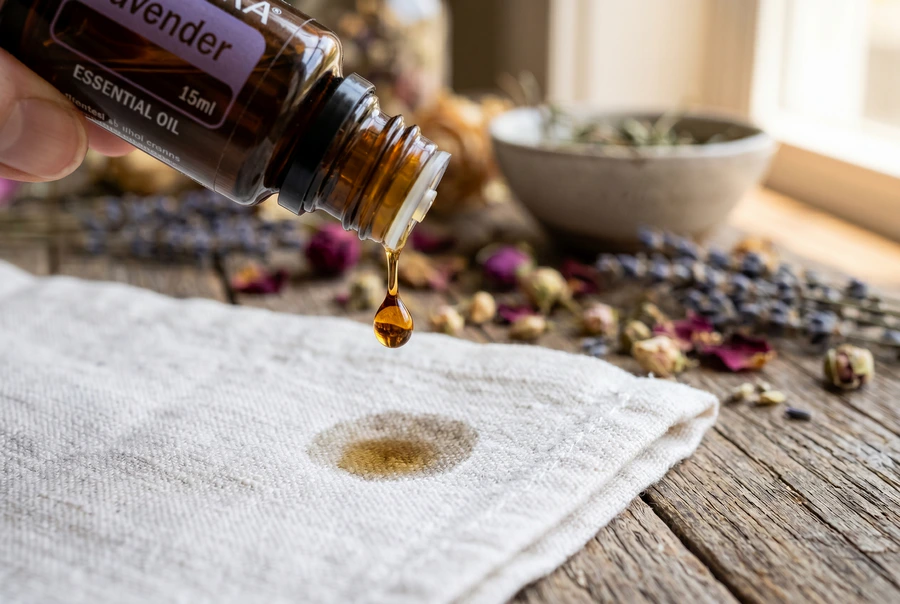
There is a simple way to check the purity of an oil without leaving home. Place a drop of essential oil on a white cloth or paper tissue and wait a few minutes.
A pure essential oil will evaporate without a trace. Despite the name, essential oils contain no fats or lipids — which is precisely why they leave no stain. If a greasy mark remains, you are looking at a blend with a carrier oil — coconut, almond, or another base.
However, there are important exceptions to this rule. Citrus oils — lemon, orange, grapefruit, bergamot — are cold pressed, not steam distilled. Natural pigments and waxes may leave faint yellow or orange marks on fabric. This is not a sign of adulteration — it is a characteristic of the production method. A mark from a citrus oil is generally not greasy to the touch and fades significantly over time.
Resinous oils — frankincense, myrrh, patchouli — behave similarly. High molecular density and slower evaporation rates may leave faint traces. This too is normal.
Lavender, peppermint, tea tree, or eucalyptus oils should not leave greasy marks. If they do, question the purity.
A diluted product is not necessarily poor. But it is not 100% pure and lacks therapeutic properties.
Every bottle holds a long journey — from field to laboratory, from dawn on a plantation to a drop in your diffuser. When you understand that journey, your relationship with choice begins to change.
An essential oil is not simply a pleasant scent. It is a living concentrate of nature. It works subtly on chemistry, energy, and inner state.
Related Posts
The hidden power of essential oils: aromatherapy as a path to inner harmony
In a world where people increasingly seek answers within themselves, essential oils are becoming not…

Aromatherapy: An Ancient Practice of Self-Discovery and Healing Through Essential Oils
Aromatherapy is not simply a wellness trend — it is an ancient healing practice tested…

How Essential Oils Are Made: From Field to Bottle
The essential oil market is vast — from cheap options in drugstores to bottles with…