
Skin by Dosha: Why Acne, Dryness and Inflammation Appear
«The radiance of the skin, its even tone, softness and delicacy — these are the signs of true health.» — Charaka Samhita
Contents
- Introduction
- Skin in Ayurveda: More Than an Outer Layer
- How to Identify Your Ayurvedic Skin Type
- Vata and the Skin
- Pitta and the Skin
- Kapha and the Skin
- Conclusion
- Frequently Asked Questions
Introduction
Modern cosmetology offers thousands of solutions for the skin. Most of them follow one principle: identify the symptom and eliminate it — redness, a spot, a breakout, dryness, acne. None of these approaches asks the central question: why is this happening in the first place? And without that question, the root of the problem remains untouched — why the symptom appeared and what needs to change so it does not return.
According to Ayurveda, which works with the root rather than the symptom, the skin is not simply an outer layer. It is a mirror of what is happening within. Every breakout, every area of dryness, every inflammation is a signal of a specific internal imbalance. Until that imbalance is addressed, no cream will produce lasting results.
At the foundation of the Ayurvedic approach to skin lies the same system that governs digestion, hormones, and energy — three constitutional energies, or doshas: Vata, Pitta, and Kapha. Each one shapes a particular skin type. Each one, when out of balance, produces its own characteristic set of problems. And each one requires its own approach — in nutrition, lifestyle, and care.
In this article, we will look at how to identify your Ayurvedic skin type, what lies behind acne, dryness, and inflammation from a doshic perspective, and which practical tools help restore balance from within and without.
Skin in Ayurveda: More Than an Outer Layer

Modern science describes the skin as an organ with three layers — epidermis, dermis, and hypodermis. Ayurveda sees it differently. According to ancient texts, the skin consists of seven layers — and each one is responsible for specific functions and vulnerable to specific imbalances.
These seven layers are called saptadhatu — “seven tissues that nourish.” They are arranged in a hierarchy: each subsequent layer is nourished by the one before it. This is why the condition of the skin is so closely connected to digestion — it is through digestion that nutrients enter the body and travel sequentially through all seven levels.
| Skin Layer (Ayurveda) | Function and Connection to the Doshas |
|---|---|
| 1. Avabhasini | Surface layer — reflects internal state, complexion, first signal of imbalance |
| 2. Lomini | Layer of hair follicles — skin nourishment, microcirculation |
| 3. Svedahara | Layer of pores and sweat glands — elimination of toxins through the skin |
| 4. Tamra | Copper layer — protection from infection, immune barrier |
| 5. Vedini | Sensitivity layer — pain, itching, response to irritants |
| 6. Rohini | Healing layer — regeneration and restoration |
| 7. Maha Dhara | Deep layer — the foundation of skin vitality, support for all others |
Why the Skin Reflects Digestion
One of the central principles of Ayurveda states that health begins with Agni — the digestive fire. When Agni is strong, food is fully processed, nutrients are absorbed, and they reach all the tissues of the body, including the skin. When Agni is weakened, Ama forms.
Ama consists of unfinished metabolic byproducts — toxins that accumulate in the tissues and clog the channels of circulation. In the context of the skin, Ama manifests in very visible ways: a dull complexion, uneven skin tone, breakouts without an obvious cause, and inflammation that does not respond to topical treatment. These are all classic signs of Ama in the skin.
Ayurveda therefore never treats the skin only from the outside. Any external care addresses only half the work. The other half is restoring Agni and eliminating Ama from within.
On how Agni works and how to restore it through nutrition: Eating for Your Dosha: Gut Health and Digestion in Ayurveda
On which skin diseases arise from doshic imbalance and how Ama works from within: Ayurvedic Skin Treatment: Acne, Eczema, Psoriasis and Dosha-Based Care
The Three Doshas and Three Zones of the Skin
In Ayurveda, each dosha governs its own level of the skin and its own processes within it.
Vata governs the surface layer of the skin — rasa. It is responsible for moisture, elasticity, and cell renewal. When Vata is out of balance, the skin loses moisture, becomes thin and rough, and is prone to premature ageing.
Pitta governs the blood and circulation within the skin — rakta dhatu. It is responsible for complexion, thermoregulation, and tissue metabolism. When Pitta is excessive, the skin becomes inflamed and red, and acne, rosacea, and pigmentation appear.
Kapha governs the muscular and connective tissue of the skin — mamsa dhatu. It is responsible for density, firmness, and deep hydration. When Kapha is out of balance, the skin becomes excessively oily, the pores enlarge, and congested breakouts and puffiness appear.
Why the Skin Changes with Stress, Food, and Season
Many people notice that the skin suddenly flares up before an important event. After a heavy festive meal, breakouts appear. In winter, the skin dries out more; in summer, it becomes oilier. Ayurveda explains this with great precision.
Stress activates Vata and Pitta — the nervous system becomes overstimulated, the blood heats up, and cortisol production rises. All of this directly affects the skin. Heavy food overloads Agni — Ama forms and seeks an exit through the skin. Seasonal changes shift the dominant dosha — winter intensifies Vata, summer intensifies Pitta, and spring intensifies Kapha.
Skincare in Ayurveda is therefore not a fixed set of procedures. It is a living system that changes together with the body, the season, and the way of life.
How to Identify Your Ayurvedic Skin Type
An Ayurvedic skin type is not the same as a cosmetological one. Cosmetology divides skin into dry, oily, combination, and normal. Ayurveda looks deeper — not only at how the skin appears right now, but at how it responds to stress, food, seasonal changes, and lifestyle.
An Ayurvedic skin type is determined not only by external characteristics, but also by internal reactions. This is why two people with outwardly similar dry skin may have completely different types — and need opposing approaches to care.
Most people will see a mixed picture in the table below — and that is normal. Doshas rarely exist in a pure form. The task is to identify the dominant pattern that appears most frequently. That pattern points to the area of primary attention.
Self-Diagnosis Checklist: What Is Your Ayurvedic Skin Type?
| Parameter | Vata | Pitta | Kapha |
|---|---|---|---|
| Skin texture | Thin, delicate, rough | Soft, medium thickness | Thick, dense, velvety |
| Moisture level | Dry, prone to flaking | Normal or slightly oily | Oily, prone to shine |
| Pores | Barely visible | Medium, visible in T-zone | Large, enlarged |
| Complexion | Dull, sallow, with dark spots | Pinkish, flushed, with freckles | Pale, even |
| Response to stress | Dryness intensifies, fine lines appear | Redness, breakouts, irritation | Oiliness increases, spots appear |
| Response to sun | Dries out quickly, loses radiance | Burns easily, turns red | Tans slowly but evenly |
| Tendency to wrinkles | Early wrinkles, especially around the eyes | Wrinkles appear later | Wrinkles appear latest of all |
| Main concerns | Dryness, flaking, wrinkles, dark spots | Acne, inflammation, rosacea, pigmentation | Oiliness, clogged pores, cystic acne |
| After cleansing | Tightness, discomfort | Light feeling of cleanliness | Oiliness remains |
| Response to winter | Heavy flaking, cracking | Redness, sensitivity | Almost no change |
| Response to summer | Improves slightly | Worsens sharply, acne intensifies | Oiliness increases |
| Ageing pattern | Fast, dry ageing | Medium, with pigmentation | Slow, retains youth longest |
A Few Important Clarifications
First — skin type can change. Prakriti — the innate constitution — remains constant. However, Vikriti — the acquired imbalance — shifts under the influence of stress, nutrition, season, and age. This is why skin that was oily at twenty may become combination or even dry by forty.
Second — imbalance does not always match the constitution. A person with a Kapha constitution may experience Pitta-type acne — if diet, lifestyle, or stress has pushed Pitta beyond its natural level. Ayurveda always works with the current state, not only with the innate type.
Third — facial skin and body skin can belong to different types. This is also normal and is taken into account when building an individual approach.
Vata and the Skin
When the Skin Lacks Nourishment
Vata is air and ether. Movement, lightness, dryness. In the skin, Vata governs the circulation of nutrients, cell renewal, and the maintenance of moisture. When Vata is in balance, the skin is thin, delicate, with barely visible pores and that porcelain quality many consider the ideal of beauty. When Vata moves out of balance, that same delicacy becomes a vulnerability.
Portrait of Vata Skin
Vata skin is the most delicate of the three types. It is thin, almost translucent, with barely visible pores. Veins show through easily. It reacts quickly to cold — reddening, tightening, flaking. This skin requires constant attention and nourishment; without it, it loses its freshness very quickly.
The defining characteristic of Vata skin is unpredictability. Today it looks soft and radiant. Tomorrow — after a sleepless night, a stressful day, or a cold wind — it dries out sharply, dulls, and flaking appears alongside a feeling of tightness. The skin literally reflects the state of the nervous system.
Vata skin also ages faster than the other types. The first wrinkles — particularly around the eyes and lips — appear earlier than in Pitta or Kapha types. This is a signal: this skin needs more nourishment and protection, starting from a young age.
Signs of Vata Imbalance in the Skin
Chronic dryness is the primary sign of imbalanced Vata. The skin is not just dry — it is rough to the touch, prone to cracking at the corners of the lips, on the hands and heels. Standard moisturisers provide temporary relief but do not resolve the problem, because the cause is internal.
A dull complexion and dark spots follow from poor microcirculation. Vata governs blood movement in the surface layers of the skin. When it is out of balance, blood supply diminishes, skin cells receive less nourishment and oxygen, and the result is a grey, sallow tone with a tendency toward hyperpigmentation.
Premature wrinkles and loss of firmness result from a deficit of moisture and fats in the deep skin layers. Vata skin produces less sebum — the natural protective fat. Without it, the skin barrier weakens, moisture evaporates faster, and elasticity declines.
Flaking and itching appear especially in cold weather or dry climates. The skin literally cracks from within due to lack of nourishment.
Anxiety and restlessness intensify all symptoms. Vata governs not only the skin but also the nervous system. Chronic stress, poor sleep, and information overload directly worsen Vata skin condition — this is physiology.
Nutrition for Vata Skin
The guiding principle is warmth, richness, and nourishment. Everything that warms and hydrates from within.
The foundation of the diet should be warm cooked meals with ghee — clarified butter, which Ayurveda considers the finest substance for nourishing the deep tissues. Soups, porridges, stewed vegetables, root vegetables — all of these support Vata and indirectly nourish the skin.
Healthy fats — avocado, nuts, sesame, coconut — are essential for Vata skin as building material for the skin barrier. A deficit of these fats in the diet directly shows up as dryness.
Raw, cold, and crunchy foods should be avoided, as should carbonated drinks and excess caffeine. All of these intensify Vata and dry the skin from within.
Care for Vata Skin
Abhyanga — oil self-massage — is the primary tool for Vata skin. Warm oil applied in circular movements to the face and body nourishes the deep skin layers, improves microcirculation, and restores the skin barrier. For Vata types, sesame oil is the best choice — it is warming, deeply nourishing, and penetrates effectively into the deeper layers.
Ubtan — the traditional Ayurvedic chickpea flour cleanser — gently exfoliates without drying. Unlike harsh scrubs, ubtan does not strip the skin barrier. It nourishes it.
Cleansing should be done with warm water only — never hot, never cold. After cleansing, oil or a nourishing cream should be applied immediately, while the skin is still damp.
Home Mask for Vata Skin
Chickpea flour — 1 tbsp. Rose water — enough to form a paste. A few drops of rose or almond oil. Apply for 10 to 15 minutes, rinse with warm water. Afterwards — apply sesame oil or a nourishing cream without delay.
Oils and Herbs for Vata Skin
| Oil / Herb | Action |
|---|---|
| Sesame oil | Warms, nourishes, restores the skin barrier |
| Almond oil | Softens, hydrates, fades dark spots |
| Kumkumadi | Comprehensive rejuvenating oil, evens skin tone |
| Ashwagandha | Reduces stress, protects against premature ageing |
| Shatavari | Hydrates and nourishes the tissues from within |
| Brahmi | Calms the nervous system, indirectly improves the skin |
| Triphala | Cleanses the gut, reduces Ama, improves skin tone |
The Key Rule
For Vata skin, routine matters more than the composition of any product. Regular sleep before 10 p.m., warm meals at consistent times, and daily Abhyanga — this system gives the skin what no cream can replace: stability and nourishment from within.
Pitta and the Skin
When the Fire Rises to the Surface
Pitta is fire and water. Transformation, intensity, heat. In the skin, Pitta governs cellular metabolism, complexion, and circulation. When Pitta is in balance, the skin glows from within, has a beautiful pinkish tone, and a natural flush. When Pitta becomes excessive, that same fire begins burning what it should not. Inflammation, redness, acne — these are Pitta seeking an exit through the skin.
Portrait of Pitta Skin
Pitta skin is the most striking of the three types. Fair or pinkish, with freckles and moles, it radiates warmth literally — to the touch, this skin feels warmer than other types. Pores are medium-sized and visible in the T-zone. The texture is soft and delicate.
Pitta skin is beautiful when in balance — and highly vulnerable when not. It reacts sharply to sun exposure: it burns easily, reddens, and develops pigmentation even after brief time outdoors. Spicy food, alcohol, heat, and stress all instantly show on the skin as redness or breakouts.
An interesting characteristic of Pitta skin: it can look perfect for weeks — and then suddenly flare into acne or rosacea during a period of stress or summer heat. This is why people with Pitta skin often describe their condition as unpredictable and difficult to control.
Signs of Pitta Imbalance in the Skin
Acne and inflammatory breakouts are the most characteristic sign of imbalanced Pitta. In Ayurveda, acne is called Yauvana Pidika — literally “flower of youth.” It is not merely a cosmetic concern. It is a signal of excess heat in the blood and Ama accumulation in the tissues. Pitta acne is distinct from other types: it is painful, red, inflamed, often with pus. It most commonly appears on the cheeks, forehead, and chin.
Rosacea — chronic redness, visible vessels on the cheeks and nose — is a classic Pitta condition. In Ayurveda it is called Rakta Pitta — literally “hot blood.” Excess heat in the blood leads to capillary dilation and persistent redness.
Pigmentation and uneven skin tone result from excess Pitta in the rakta dhatu — the blood tissue. Pitta skin is particularly prone to post-inflammatory pigmentation: even a small spot leaves a dark mark that takes a long time to fade.
Sensitivity and burning — Pitta skin reacts sharply to products containing acids, alcohol, and synthetic fragrances. What works well for other skin types causes irritation for Pitta.
Premature greying and hair loss — excess Pitta affects not only the facial skin but also the hair follicles. This is one of the less obvious yet characteristic signs of Pitta imbalance.
Nutrition for Pitta Skin
The guiding principle is cooling and calming. Everything that reduces internal heat.
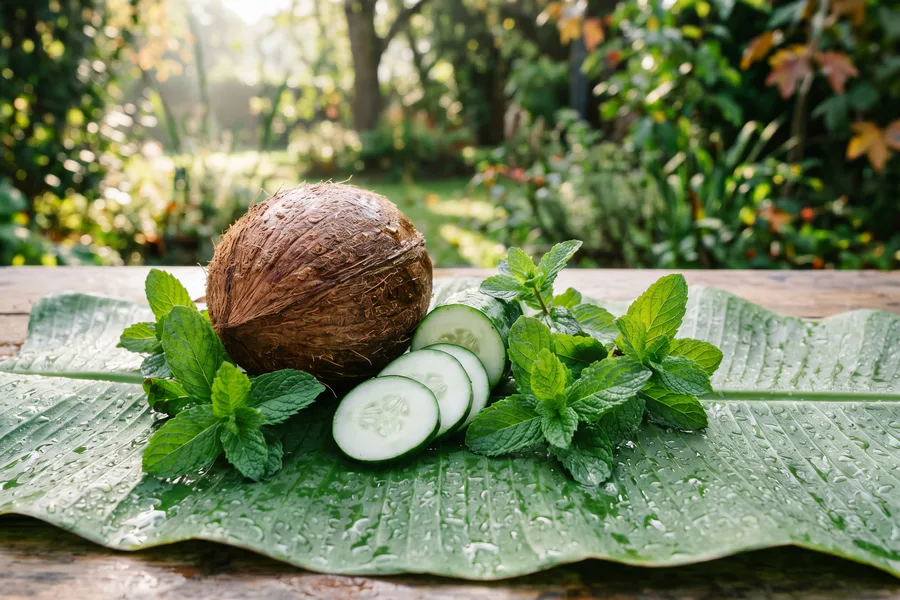
The foundation of the diet should be cooling foods: cucumber, zucchini, coconut milk, leafy greens, sweet fruits — pears, melon, grapes. Bitter and astringent tastes are the best allies for Pitta skin. They stimulate bile flow, support the liver, and help clear excess heat through digestion.
The liver is the key organ for Pitta skin. It metabolises excess hormones and toxins that would otherwise exit through the skin as acne and inflammation. Supporting the liver through nutrition is therefore direct skincare work.
If the liver is already overloaded and the skin is signalling this through inflammation, a gentle cleanse can be the first step. Easy Detox, 3-Day Detox and 7-Day Detox programmes were created for exactly this: clearing accumulated Ama without stress to the system, grounded in Ayurvedic principles of nutrition.
Spicy, sour, and fried foods should be avoided, as should alcohol, excess caffeine, and tomatoes. All of these intensify Pitta and provoke breakouts. Hot drinks and food are also best avoided during flare-ups.
Care for Pitta Skin
The guiding principle of external care is cooling, soothing, and minimalism. Pitta skin does not tolerate aggression: no alcohol-based toners, no acid peels during active flare-ups, no harsh scrubs.
Cleansing should be done with cool or room-temperature water. Hot water immediately intensifies redness and dilates blood vessels.
Rose water and aloe vera are the foundation of daily care for Pitta skin. Rose water cools and tightens pores. Aloe reduces inflammation and accelerates healing.
Abhyanga for Pitta skin uses coconut oil at room temperature. Coconut has a pronounced cooling effect and soothes irritated skin effectively.
Sun protection is essential. Pitta skin burns quickly and responds to UV exposure with inflammation. Mineral sunscreens based on zinc oxide are preferable to chemical filters, which may additionally irritate sensitive skin.
Home Mask for Pitta Skin
Fine oat flakes — 1 tbsp. Cold milk or water — enough to form a paste. Apply for 10 to 15 minutes, rinse with cool water. Afterwards — a light moisturiser.
Oils and Herbs for Pitta Skin
| Oil / Herb | Action |
|---|---|
| Coconut oil | Cools, soothes, reduces redness |
| Sandalwood oil | Anti-inflammatory, evens skin tone, tightens pores |
| Kumkumadi | Fades pigmentation, restores skin tone |
| Neem | Antibacterial, purifies the blood, fights acne |
| Turmeric | Anti-inflammatory, antibacterial, brightening |
| Manjistha | Purifies the blood, fades dark spots, tones the skin |
| Amalaki | Antioxidant, restores skin after inflammation |
| Guduchi | Cools the system from within, reduces inflammation |
The Key Rule
For Pitta skin, the primary enemy is an imbalanced lifestyle. Chronic stress, poor sleep, spicy food, and alcohol heat Pitta faster than any external factor. No mask will calm skin that a lifestyle continues to inflame. The first step in caring for Pitta skin is therefore not a new product — it is reducing the internal fire.
Kapha and the Skin
When the Skin Accumulates Too Much
Kapha is earth and water. Stability, density, moisture. In the skin, Kapha governs firmness, thickness, and deep hydration. When Kapha is in balance, the skin is rich, soft, smooth, with a beautiful natural glow. It ages more slowly than the other types and retains its youthfulness longest. When Kapha becomes excessive, that same density becomes the problem. Pores clog, sebum accumulates, and the skin loses its freshness.
Portrait of Kapha Skin
Kapha skin is the most resilient and long-lasting of the three types. Thick, dense, velvety to the touch, with enlarged pores and a tendency toward oily shine. Wrinkles are practically absent in youth — firmness is maintained significantly longer than in Vata or Pitta types.
However, that same density creates conditions for accumulation. Excess sebum mixes with dead skin cells and impurities, clogs the pores, and creates ideal conditions for bacterial growth. This is why Kapha skin is prone to a particular type of acne — cystic, deep, painful, which does not surface but sits beneath the skin for weeks.
The defining characteristic of Kapha skin is the slowness of its reactions. It adapts slowly to new products, responds to treatment slowly, and accumulates imbalance just as slowly — but inevitably — if not attended to consistently.
Signs of Kapha Imbalance in the Skin
Excess oiliness and persistent shine are the primary signs of imbalanced Kapha. The skin becomes oily within an hour of cleansing, foundation slides, and mattifying products help only briefly. The cause is not the skin itself but an excess of Kapha qualities from within: heavy nutrition, a sedentary lifestyle, and daytime sleep.
Cystic acne presents as deep, painful inflammations beneath the skin without a visible head. Unlike Pitta acne — which is red and hot — Kapha acne is cold, congested, and slow to develop. It most commonly appears along the chin, cheeks, and neck.
Enlarged pores and blackheads follow from the constant excess of sebum. The pores physically stretch from accumulated contents and lose their ability to self-cleanse.
Puffiness and pastosity — particularly in the morning and around the face. Kapha retains water by nature. When out of balance, fluid retention becomes chronic and visible.
Dullness and loss of freshness — despite Kapha skin originally having a beautiful even tone, in imbalance it takes on a sallow, unhealthy appearance. The skin looks heavy and tired even after rest.
Fungal infections — Kapha skin creates a moist environment that is favourable for fungal growth. This is why Kapha types are more prone to seborrhoeic dermatitis and other fungal skin conditions.
Nutrition for Kapha Skin
The guiding principle is lightness, warmth, and stimulation. Everything that kindles Agni and helps eliminate excess.
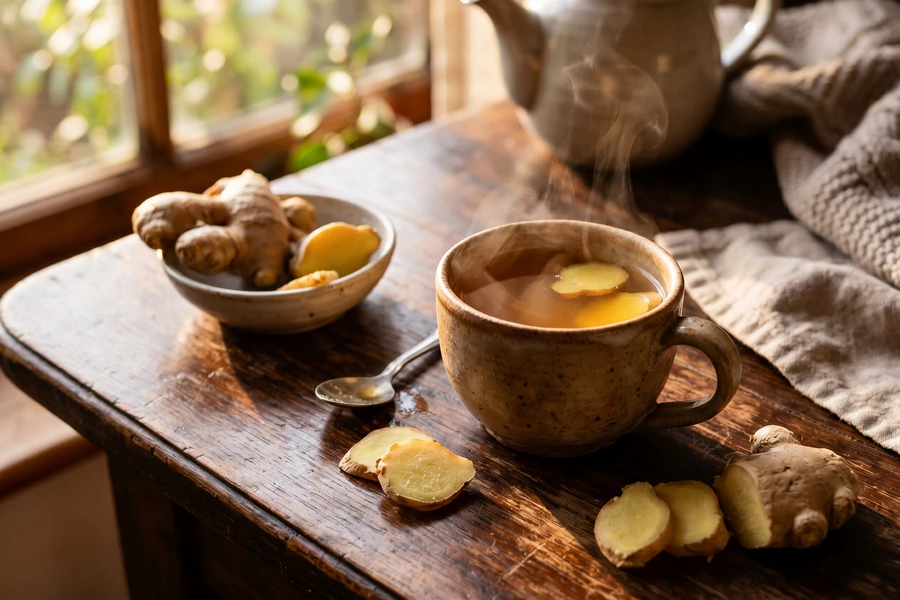
The foundation of the diet should be light cooked vegetables, legumes, and bitter greens. Pungent, bitter, and astringent tastes are the best allies for Kapha skin. They stimulate Agni, accelerate metabolism, and help clear mucus and toxins.
Warming spices — ginger, black pepper, turmeric, cloves — are especially important for Kapha types. They literally kindle the internal fire and improve the metabolism of skin tissues.
Heavy dairy products — milk, cheese, sour cream — should be limited, as should sugar, fatty food, and cold food. All of these intensify Kapha and directly affect the skin: oiliness increases and new breakouts appear.
Care for Kapha Skin
The guiding principle of external care is cleansing, stimulation, and lightness. Kapha skin needs regular deep cleansing that would be excessive for the other types.
Ubtan with warming spices is the classic Ayurvedic preparation for Kapha skin. Chickpea flour with turmeric, ginger, or black pepper gently exfoliates, stimulates circulation, and regulates sebum production. Use two to three times per week.
Clay masks — multani mitti (fuller’s earth) or kaolin clay — absorb excess sebum, tighten pores, and detoxify the skin. These are the foundational tools of Kapha skincare.
Dry brushing — garshana — stimulates lymphatic drainage, improves microcirculation, and helps draw toxins out through the skin. For the face, a soft brush or a natural silk mitt is used.
Cleansing with warm water, twice daily. Unlike Pitta skin, Kapha skin is not harmed by warm water — it helps open the pores and clear excess sebum.
Abhyanga for Kapha skin uses light oils. Mustard oil or jojoba oil is preferable to heavier options such as sesame or almond — they do not weigh the skin down while still stimulating circulation.
Home Mask for Kapha Skin
Tomato juice or fresh tomato pulp — apply to cleansed skin for 10 to 15 minutes, rinse with warm water. The natural acids in tomato gently cleanse the pores and regulate sebum production.
Oils and Herbs for Kapha Skin
| Oil / Herb | Action |
|---|---|
| Mustard oil | Warms, stimulates circulation, antibacterial |
| Jojoba oil | Light, regulates sebum, does not clog pores |
| Neem | Antibacterial, antifungal, cleanses pores |
| Turmeric | Anti-inflammatory, antibacterial, clarifying |
| Trikatu | Ginger + black pepper + long pepper — kindles Agni |
| Tulsi | Antibacterial, purifies the skin and blood |
| Manjistha | Purifies lymph and blood, clears congested spots |
| Guggulu | Detoxifying, helps with cystic acne |
The Key Rule
For Kapha skin, movement matters more than any product. Physical activity — walks, yoga, any regular movement — kindles Agni, improves lymphatic flow, and accelerates the metabolism of skin tissues. No mask will achieve what consistent movement combined with light nutrition can. The skin begins to change when the lifestyle changes.
Conclusion
Learning to Listen
Acne that appears every month before menstruation. Dryness that persists despite expensive creams. Redness that intensifies during stress. None of this is coincidence. It is the language the skin uses to communicate what is happening within.
Ayurveda does not suggest silencing that language. It offers a way to read it. Behind every symptom lies a specific doshic imbalance. Behind every imbalance lies a specific cause — in nutrition, lifestyle, or emotional state. And every cause has a solution — not a cosmetic one, but a systemic one.
Three principles unite everything covered in this article:
The first — the skin heals from within.
No cream, no serum, and no procedure will produce lasting results while Agni is weak and Ama accumulates in the tissues. Restoring digestion is the first and essential step toward healthy skin.
The second — the cause matters more than the symptom.
Pitta acne and Kapha acne look similar but require opposite approaches. Vata dryness and Pitta skin dehydration are different conditions with different solutions. Knowing your type is the key to understanding your nature.
The third — consistency matters more than intensity.
Daily Abhyanga over a month will achieve more than the most expensive weekly mask. A glass of warm water in the morning, ginger tea, bitter greens at the end of lunch, going to bed before 10 p.m. — these small actions, applied consistently, change the condition of the skin at the tissue level.
A start can be made with something small. Identify your type using the checklist in this article. Remove the primary provocation for your dosha from the diet. Add one oil for daily massage. Try ubtan instead of a foaming cleanser. Consistent small actions create that stable inner state which Ayurveda calls ojas — the vital essence that literally shines through the skin.
For those who want to move in this direction with awareness and support — the Vedic Knowledge Club has gathered everything needed: knowledge, tools, and practices for working with your own nature.
This material is for informational purposes only and does not replace medical advice. Before starting any Ayurvedic practices or changing your skincare routine — consult a doctor, especially if you have chronic skin conditions.
Frequently Asked Questions
How does Ayurveda explain adult acne?
Adult acne is not a teenage problem that has lingered. From an Ayurvedic perspective, it is a signal of active doshic imbalance — most often Pitta or Kapha — combined with Ama accumulation in the blood. In adults, the primary triggers are chronic stress, hormonal changes, excess spicy and fatty food, alcohol, and disrupted sleep. All of these factors heat Pitta or intensify Kapha — and the skin responds with breakouts. This is why adult acne so often does not respond to topical treatment: its cause lies deeper than the surface of the skin.
What is ubtan and why is it better than a regular foaming cleanser?
Ubtan is a traditional Ayurvedic skin cleanser made from chickpea flour. Unlike most modern foaming cleansers and gels, ubtan contains no surfactants — the harsh cleansing agents that strip the skin barrier and wash away the protective lipid layer. Ubtan cleanses gently while simultaneously nourishing and lightly exfoliating the skin. Chickpea flour absorbs excess sebum without drying the skin. The liquid base — milk, rose water, or aloe — is chosen according to skin type and provides additional nourishment or cooling. The result is clean but not tight skin, without the sensation of being “squeaky clean.”
Why does the skin worsen during periods of stress?
Stress is one of the primary triggers of skin problems in Ayurveda — and modern science confirms this. During stress, the sympathetic nervous system activates and cortisol production rises sharply. Cortisol increases sebum production, triggers inflammation, and breaks down collagen. This is why breakouts appear, the skin loses firmness, and the complexion dulls during difficult periods. In Ayurvedic terms, stress activates Vata and Pitta simultaneously. Vata dries the skin and disrupts its nourishment. Pitta inflames. In addition, stress weakens Agni and initiates Ama accumulation, which seeks an exit through the skin. No external care will produce lasting results until chronic stress is reduced.
Related Posts

What Is a Dosha: The Three Energies That Define Our Nature
Ayurveda is one of the oldest systems of medical knowledge in the world. Its history…

Hormones and Women’s Health Through the Doshas: An Ayurvedic Perspective on Balance
Contents: Introduction What Are Hormones and Why Do They Fall Out of Balance? The Ayurvedic…

Eating for Your Dosha: Gut Health and Digestion Through Ayurveda
Contents Introduction Agni — The Digestive Fire That Matters More Than Any Diet The Four…