
Hormones and Women’s Health Through the Doshas: An Ayurvedic Perspective on Balance

Contents:
- Introduction
- What Are Hormones and Why Do They Fall Out of Balance?
- The Ayurvedic View of Hormones
- The Three Doshas and Women’s Hormonal Health
- Hormones Through the Phases of the Cycle: Ayurveda from Within
- The Three Ages of a Woman: How Hormones Shift
- Restoring Balance: A Practical Ayurvedic Approach
- Adaptogenic Herbs: The Ayurvedic Pharmacy for Hormones
- Conclusion
Introduction
Unexplained fatigue, mood swings in the week before your period, waking at 3 a.m., weight gain with no clear cause — all of this tends to get written off as stress or age. Yet each of these signals has a specific reason behind it. And that reason runs far deeper than it might appear.
Hormonal imbalance has become one of the most widespread women’s health challenges of our time. In fact, research suggests that the majority of women of reproductive age experience some form of it — from painful periods and pronounced PMS to PCOS (polycystic ovary syndrome) and difficult menopause. Conventional medicine offers symptomatic solutions. Ayurveda, however, — the ancient Indian science of life, with a history spanning over five thousand years — offers something fundamentally different: understanding and addressing the root cause.
At the heart of the Ayurvedic approach lies a simple but profound idea: a woman’s body is not a collection of separate systems and organs, but a unified living organism. As a result, hormones don’t exist in isolation from digestion, sleep, emotions, and lifestyle. Everything is interconnected. That is precisely why Ayurveda never treats a symptom in isolation — it restores balance to the entire system.
In this article, we explore how the three core constitutional energies — the doshas — govern a woman’s hormonal health at every stage of life. We also look at what signs point to an imbalance in each of them, and what tools — from nutrition and daily routine to adaptogenic herbs — help restore equilibrium.
What Are Hormones and Why Do They Fall Out of Balance?
50 Chemical Messengers: How Hormones Run the Female Body
Scientists have identified over 50 hormones in the human body. Each one is a chemical messenger that travels through the bloodstream, carrying signals to cells, tissues, and organs. In essence, hormones tell the body what to do and when.
Melatonin signals the body that it’s time to sleep. Dopamine drives motivation and the sense of pleasure. Cortisol mobilizes resources in stressful situations. Estrogen and progesterone govern the reproductive cycle. Insulin regulates blood sugar. Thyroxine controls the rate of metabolism.
The sphere of hormonal influence is enormous:
Physical health — weight, skin and hair quality, energy levels, digestion, blood pressure, immunity.
Emotional wellbeing — mood, anxiety, the ability to handle stress, sleep quality.
Reproductive health — cycle regularity, fertility, the course of pregnancy, menopausal symptoms.
Hormones are produced by specialized glands that together form the endocrine system. An interesting detail: the location of these glands in the body closely mirrors where ancient yogis placed the chakras. The pituitary gland — the “third eye.” Thyroid — the throat chakra. And the adrenal glands — the root chakra. This parallel is not coincidental: Eastern traditions worked with these same regulatory centers for millennia, just in a different language.
Why Hormonal Balance Gets Disrupted
Hormones don’t exist in a vacuum. Their production, balance, and metabolism are shaped by an enormous range of factors — both internal and external.
Chronic stress is one of the primary disruptors of hormonal balance. Chronically elevated cortisol blocks the synthesis of sex hormones, suppresses thyroid function, and gradually depletes the adrenal glands.
Nutrition — nutrient deficiencies, excess sugar and processed foods, irregular meal timing — all of this directly affects hormonal health.
Toxic load — synthetic ingredients in cosmetics, plastic packaging, and pesticide residues in food contain what are known as endocrine disruptors. Once inside the body, they insert themselves into hormonal pathways: mimicking the body’s own hormones or blocking their receptors, disrupting normal hormonal communication.
Disrupted sleep and daily routine — the body is synchronized with natural cycles. Late bedtimes, irregular eating, and insufficient movement break this synchronization — and with it, the hormonal rhythm.
Age and life transitions — puberty, pregnancy, the postpartum period, and menopause are natural points of hormonal transformation. Each one requires particular attention and support.
Genetic predisposition — certain tendencies toward hormonal imbalances are inherited. Ayurveda emphasizes, however, that predisposition is not destiny. Lifestyle choices can significantly shift even genetically influenced patterns.
One important thing to understand: hormonal imbalance rarely appears out of nowhere. It’s a cumulative process. The body sends signals long before serious symptoms emerge. Learning to recognize those signals is the first and most important step toward restoring balance.
The Ayurvedic View of Hormones
When the Vedas Described Hormones Without Knowing the Word
The word “hormone” doesn’t appear in Ayurvedic texts. Yet the entire system of Ayurvedic knowledge — herbs, practices, daily routine, nutrition — was built precisely to support what modern science calls hormonal balance.

Ayurveda views the body as a whole. Health in this tradition isn’t the absence of disease — it’s a state of equilibrium between three fundamental forces, the body’s tissues, and its channels of circulation. When that equilibrium is disturbed, symptoms appear. At first barely noticeable, then increasingly pronounced.
The Three Doshas — Three Governing Forces
At the foundation of Ayurvedic philosophy lies the concept of five primary elements: ether, air, fire, water, and earth. From their combinations arise three constitutional energies — the doshas. These govern all physical and psychological processes in the body.
Vata — the energy of movement. Composed of ether and air. It governs the nervous system, hormonal function, breathing, and everything that moves in the body — including the other two doshas. Without Vata, Pitta and Kapha cannot act.
Pitta — the energy of transformation. Composed of fire and water. It governs digestion, metabolism, heat regulation, and all chemical processes in the body — including the synthesis and metabolism of hormones.
Kapha — the energy of structure. Composed of water and earth. It provides stability, joint lubrication, immunity, and tissue building.
Every person is born with a unique ratio of the three doshas — this is called prakriti (individual constitution). Under the influence of stress, diet, seasonal change, and lifestyle, this original balance gradually shifts. This acquired state of imbalance is called vikriti in Ayurveda. It is vikriti that becomes the source of disease and hormonal disruption.
For a deeper look at the nature of each dosha, see the article “What Is a Dosha: Three Types of Energy That Define Your Nature.”
Agni — The Digestive Fire and Its Connection to Hormones
One of the central principles of Ayurveda states: health begins with digestion. Agni — the digestive fire — is not simply the ability to digest food. It is a metabolic force that permeates every cell of the body.
Ayurveda recognizes seven layers of tissue — dhatu (from the Sanskrit meaning “that which nourishes”): plasma, blood, muscle, fat, bone, nerve tissue, and reproductive tissue. Each layer is nourished by the one before it. Each has its own agni — dhatu-agni — a cellular fire that processes nutrients and passes the essence along the chain.
In modern science, hormones are chemical messengers within the body. In Ayurveda, this function is carried out by dhatu-agni: cellular fire organized by function — digestion, reproduction, immunity.
When agni is weakened — by stress, poor nutrition, or disrupted routine — nutrients are not fully absorbed. Tissues receive inadequate nourishment. Hormones are synthesized in insufficient amounts or in disrupted ratios.
Ama — Toxins as the Root of Imbalance
The consequence of weakened agni is the accumulation of ama — the undigested metabolic byproducts that Ayurveda refers to as toxins. Ama is a real physiological phenomenon: the products of incomplete metabolism that accumulate in the tissues and block the channels of circulation.
In Ayurveda, the channels of circulation are called srotas. They carry nutrients, hormones, nerve impulses, and metabolic waste. When the srotas are blocked by ama — cellular communication breaks down, tissue metabolism deteriorates, and waste accumulates. Ayurveda considers this the root of most chronic disease, including hormonal disorders.
Modern science confirms this view in different language: low-grade inflammation, gut microbiome disruption, and the accumulation of endocrine disruptors in the tissues are all modern-day analogs of ama.
The HPA Axis: Where Ayurveda and Modern Science Meet
Modern endocrinology places particular emphasis on the HPA axis — the system linking the hypothalamus, pituitary gland, and adrenal glands (Hypothalamic-Pituitary-Adrenal axis). This system regulates the stress response and maintains hormonal homeostasis — the stable equilibrium of all the body’s systems.
In Ayurveda, the hypothalamus and pituitary are governed by Vata and Pitta. The adrenal glands — primarily by Vata, with Pitta and Kapha also involved. Thyroid — by Pitta. The pancreas — by Kapha. And the ovaries — by Kapha with elements of Pitta.
When the HPA axis is overburdened by chronic stress, the entire system begins to break down. This is precisely why Ayurveda regards supporting the nervous system and reducing stress as the first and non-negotiable step in restoring hormonal health.
The Three Doshas and Women’s Hormonal Health
Which Dosha Is Running the Show Right Now?
All three doshas participate in women’s hormonal health simultaneously. Each one, however, has its own zone of responsibility — and its own characteristic pattern of imbalance. Understanding that pattern makes it possible to work with the source of a problem, not just its surface symptoms.
Vata: Movement, the Nervous System, and Hormonal Rhythm
Vata governs everything that moves in the body — including hormonal signals. It is Vata that maintains the rhythm of the menstrual cycle, transmits nerve impulses to the endocrine glands, and ensures the timely release of hormones.
Vata’s greatest enemies are irregularity and stress. Skipped meals, working late into the night, constant rushing, and information overload deplete this dosha faster than anything else.
Signs of Vata imbalance: Irregular or absent menstrual cycles. Scanty, painful periods with dark blood. Pronounced anxiety and restlessness before menstruation. Sleep disturbances — difficulty falling asleep or frequent waking during the night. Dryness of the skin, mucous membranes, and joints. Sharp mood swings. Unexplained weight loss. Chronic fatigue despite an outwardly active lifestyle.
Vata is particularly vulnerable during menopause — this is the phase of life when Vata becomes the dominant dosha. Hot flashes, night sweats, insomnia, and emotional instability during the climacteric period are all classic expressions of Vata imbalance.
Pitta: Fire, Inflammation, and Hormonal Intensity
Pitta governs transformation — including the metabolism of hormones in the liver. The liver is responsible for breaking down and clearing excess estrogen. When Pitta is excessive, the liver becomes overburdened, estrogen accumulates, and what is known as estrogen dominance develops.
The main Pitta aggravators are spicy and fatty foods, alcohol, excess caffeine, overheating, and suppressed emotions — anger, frustration, perfectionism.
Signs of Pitta imbalance: Heavy, painful periods with bright red blood and clots. Pronounced PMS with irritability, anger flare-ups, and headaches. Hormonal breakouts — particularly along the chin and cheeks. Breast tenderness and swelling before menstruation. Diarrhea or digestive upset during the cycle. Hot flashes — both premenstrually and during menopause. A tendency toward inflammatory conditions in the reproductive system — endometriosis, cysts.
Pitta women often describe their experience as “an inner fire that’s hard to control.” High productivity gives way to emotional burnout. The cycle may run perfectly for stretches, then suddenly fall apart under stress or heat.
Kapha: Structure, Accumulation, and Hormonal Sluggishness
Kapha governs tissue building and structural maintenance. In the reproductive system, it is responsible for the health of the endometrium, the quality of cervical mucus, and the normal functioning of the ovaries. However, excess Kapha creates conditions for accumulation — excess weight, fluid retention, cysts, and tissue overgrowth.
The main Kapha aggravators are a sedentary lifestyle, heavy sweet foods, excess dairy, daytime napping, and emotional eating.
Signs of Kapha imbalance: Heavy, prolonged periods with thick, dark blood. Pronounced swelling and fluid retention before menstruation. Weight gain, particularly around the hips and abdomen. Slow metabolism and difficulty losing weight. Lethargy, excessive sleepiness, apathy, and low mood. A tendency toward cyst formation — ovarian, breast. Hypothyroidism and insulin resistance as expressions of chronic Kapha imbalance. PCOS is viewed in Ayurveda primarily as a Kapha disorder.
Kapha imbalance develops slowly and gradually. This is precisely why it often goes unnoticed until symptoms become pronounced.
When the Doshas Work Together
In real life, imbalance rarely affects just one dosha. Most often the disruption begins in Vata — the most mobile and vulnerable energy — and gradually pulls Pitta and Kapha out of balance as well. This is why the Ayurvedic approach always starts with restoring Vata: the nervous system, daily rhythm, and regularity — as the foundation for everything else.
Hormones Through the Phases of the Cycle: Ayurveda from Within
The Cycle as Four Seasons in a Single Month
The menstrual cycle is not simply a physiological process. From an Ayurvedic perspective, it is a living rhythm in which the dominant energy shifts every few weeks. Along with it shift physical state, emotional tone, energy levels, and the body’s needs.
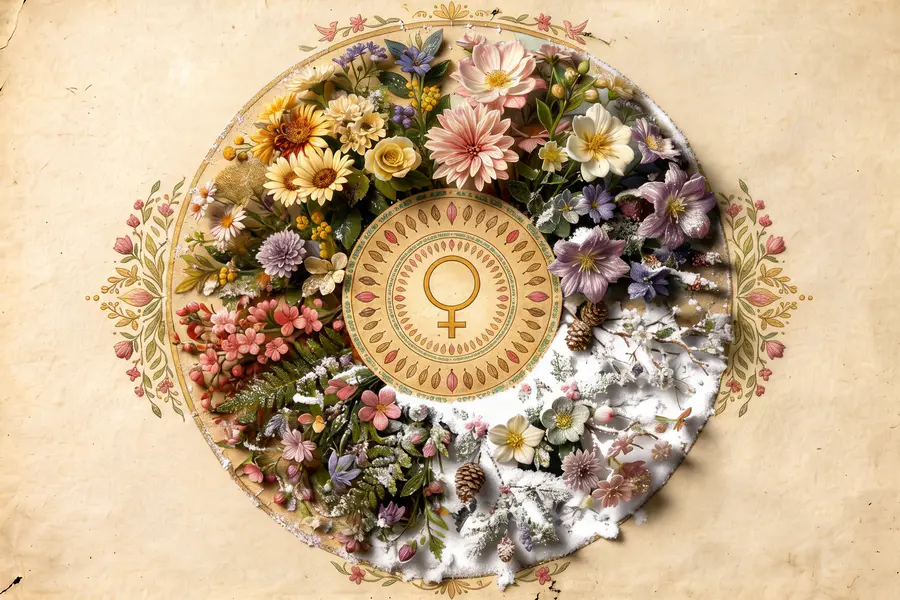
When a woman lives in alignment with this rhythm, the cycle flows easily. When she works against it, imbalance accumulates — and sooner or later, symptoms appear.
Menstruation — Vata: A Time of Movement and Rest
The first phase of the cycle — menstruation — is governed by Vata, the energy of movement. Physiologically, this is a precise match: it is the downward movement of energy, which Ayurveda calls Apana Vayu (one of the five expressions of Vata movement), that drives the flow of menstrual blood.
During this time, estrogen and progesterone are at their lowest. This is a natural state — the completion phase of the cycle. The body turns inward. Energy is directed toward cleansing, not activity.
Characteristic states in the Vata phase: mild introversion and a desire for solitude, heightened sensitivity to stress, a tendency toward anxiety when Vata is excessive, a need for warmth and quiet.
How to support yourself during this time: Warm, easily digestible foods — soups, porridges, stewed vegetables. Avoiding inversions in yoga, which disrupt the natural downward movement. Gentle, restorative practices instead of intense workouts. Warmth, rest, and minimizing stress. Adequate fluids and healthy fats — ghee, avocado, nuts.
The Follicular Phase — Kapha: A Time of Building and Growth
After menstruation comes the follicular phase — governed by Kapha, the energy of structure and nourishment. Estrogen begins to rise. The endometrium thickens in preparation for a possible pregnancy. The body is literally building and storing.
This is felt at the level of wellbeing too: more energy arrives, mood lifts, and stress tolerance rises. Metabolism slows slightly — the Kapha nature of this phase supports accumulation, not expenditure.
Characteristic states in the Kapha phase: a sense of stability and fullness, good physical endurance, calm and steady mood, possible mild heaviness or puffiness when Kapha is excessive.
How to support yourself during this time: Light, cleansing foods — kitchari (a traditional Ayurvedic dish of rice and lentils), broths, fresh vegetables. Active physical movement — the body is ready for it. Agni-kindling practices: ginger tea, warming spices, cooked foods. Limiting heavy dairy and sweets.
Ovulation and the Premenstrual Phase — Pitta: A Time of Fire and Intensity
Ovulation is the hormonal peak of the cycle. Estrogen reaches its maximum, basal body temperature rises. This is Pitta’s time — the energy of fire, transformation, and intensity.
During ovulation, women typically feel most extroverted, socially engaged, and confident. This is biologically driven: the hormonal peak supports social activity and mental clarity. After ovulation, estrogen drops and progesterone rises — and if Pitta has nowhere to go, irritation, heat, and inflammation begin to build.
Characteristic states in the Pitta phase: high productivity and sharp focus at ovulation, building irritability in the premenstrual days, elevated body temperature and sweating, heightened sensitivity to injustice and conflict, vivid dreams.
How to support yourself during this time: Cooling foods in the premenstrual days — cucumber, coconut milk, mint, leafy greens. Avoiding spicy, fatty, and acidic foods. Moderate physical activity — swimming, yoga, walking instead of intense training. Emotional processing practices — meditation, breathwork, journaling. Limiting coffee and alcohol, which amplify Pitta.
When the Cycle Is a Mirror of Health
Ayurveda views the menstrual cycle as one of the most important diagnostic tools available. Cycle regularity, the nature of the flow, the color of the blood, the presence and intensity of symptoms — all of this carries information about the state of the doshas and the overall health of the system.
No PMS symptoms, a regular pain-free cycle, and easy menstruation — this is what Ayurveda considers the norm. Everything else is a signal that deserves attention.
The Three Ages of a Woman: How Hormones Shift
Ayurveda Knew About Menopause Thousands of Years Before Endocrinology
Ayurveda doesn’t divide a woman’s life into “before” and “after.” It sees a continuous process of transformation in which each stage has its own beauty and its own tasks. Each period is governed by its own dosha — and calls for its own approach to nutrition, lifestyle, and support.

Up to Age 21 — Kapha: Laying the Foundation
The period of growth and maturation is governed by Kapha — the energy of building and nourishment. This is the time when the foundation of hormonal health is laid for decades to come. Kapha supports the formation of reproductive tissues, the establishment of the menstrual cycle, and the normalization of sex hormone production.
The main threats at this age are chronic stress and irregular eating. Academic pressure, exams, and the emotional volatility of adolescence create a constant background of anxiety. Eating on the run and skipping meals lead to deficiencies in iron, B vitamins, and other key nutrients. The result — digestive disruption and the first hormonal imbalances.
An important health marker at this age is a regular menstrual cycle with no significant symptoms. Irritability, breast tenderness, and lower abdominal pain before a period are not normal. They are signals that the system is already out of balance.
Ayurvedic support in young adulthood: Warm, regular, nourishing meals — the foundation of hormonal health. Gentle yoga and pranayama to reduce stress. A consistent daily routine that includes adequate sleep. Limiting stimulants — coffee, energy drinks, sugar. Mild adaptogenic herbs to support the nervous system may be helpful at this age, though any herbal preparations should be taken only under the guidance of a qualified practitioner.
Ages 21–45 — Pitta: Fertility and Hormonal Activity
The reproductive years are governed by Pitta — the energy of transformation and fire. This is the most hormonally active period of a woman’s life. Pitta governs cycle regularity, ovulation quality, estrogen metabolism in the liver, and overall hormonal balance.
A serious challenge of this period is toxic load. Synthetic cosmetics, plastic packaging, and preservative-laden foods contain endocrine disruptors — substances that mimic estrogen and disrupt hormonal balance. The result is estrogen dominance, which manifests as pronounced PMS, painful periods, fibrocystic changes, and cycle irregularities.
Ayurveda recommends beginning preconception preparation at least a year before a planned pregnancy. This time is used to address even minor health imbalances in both partners — an approach that significantly reduces the likelihood of genetic predispositions expressing in the child.
Key plants in the reproductive years:
For restoring and maintaining hormonal balance during the reproductive years, Ayurveda relies primarily on two plants — Shatavari and Ashwagandha. Their full descriptions, properties, dosages, and contraindications are in Section 7, “The Ayurvedic Pharmacy for Hormones,” below.
After Age 45 — Vata: Menopause and Transformation
From an Ayurvedic perspective, the third stage of life is governed by Vata — the energy of movement and space. Vata’s defining quality is dryness. This is precisely why the menopausal transition so often brings dryness of the mucous membranes, skin, and joints.
During this time, ovarian function gradually declines, and levels of estrogen, progesterone, and testosterone fall. The compensatory load shifts to the adrenal glands — which take over sex hormone production after menopause. Supporting the adrenals at this stage is not optional; it is essential.
In parallel with these hormonal changes, agni — the digestive fire — inevitably weakens. The body produces fewer enzymes and less bile. Nutrient absorption deteriorates even when the diet is sound.
Ayurveda holds firmly to one principle: rejuvenating therapy — rasayana (from Sanskrit meaning “path to the essence,” a system of deep tissue renewal) — cannot begin until digestion has been restored and inflammatory processes have been resolved. The first step in menopause is therefore restoring agni, not reaching for tonics and adaptogens.
Herbal support in menopause:
During menopause, Ayurveda draws on a full range of plants: Shatavari, Ashwagandha, Fenugreek, Tulsi, and Maca. Each addresses a specific need — from adrenal support to reducing hot flashes and restoring sleep quality. Full descriptions of each plant, indications, and contraindications are in Section 7 below.
Three Ages — One Wisdom
Puberty is the laying of a foundation. The reproductive years are the peak of activity and creation. Menopause is a time of deepening, wisdom, and release. Each of these periods calls for particular attention. The underlying principle, however, remains constant throughout: the body always signals its needs — the work is learning to listen.
Restoring Balance: A Practical Ayurvedic Approach
From Dinacharya to Adaptogens — What Actually Works
Understanding the doshas and their influence on hormones is valuable in itself. But even more valuable are the concrete tools that can be applied in daily life.
Dinacharya — Daily Routine as the Foundation of Hormonal Health
Dinacharya (from Sanskrit meaning “daily action”) is the Ayurvedic daily routine, structured in alignment with the body’s natural rhythms. Modern science calls these rhythms circadian. Ayurveda, notably, described them thousands of years ago.
When waking, eating, physical activity, and sleep happen at consistent times, the endocrine system operates predictably and efficiently. As a result, the glands prepare in advance for each phase of the day, and hormones are released on time and in the right proportions.
A disrupted routine — late bedtimes, skipped meals, irregular exercise — is not simply uncomfortable. In fact, it sends a chaotic signal to every cell of the endocrine system. For a closer look at what happens at the molecular level inside the cell when this kind of chaos sets in, see the article “The Cell’s Energy Source: How the Body Works from the Inside Out.”
The core elements of Dinacharya for hormonal health include the following:
Waking by 6–7 a.m. — in alignment with the natural cortisol rhythm, which peaks in the early morning hours. A glass of warm water on an empty stomach — activates peristalsis and supports toxin elimination. Morning practices before breakfast — yoga, pranayama, or meditation — effectively lower baseline cortisol. The main meal at midday — when agni is at its strongest. Finally, bedtime no later than 10:30 p.m. — the window between 10 p.m. and 2 a.m. is when growth hormone is most actively produced and tissue repair takes place.
Agni — The Digestive Fire as the Foundation of Hormonal Health
Ayurveda holds that all disease begins with disruption of agni. This is especially true for hormonal health — since many hormones are synthesized from the nutrients that reach the body through digestion.
Four key rules for healthy digestion, supported equally by Ayurveda and modern nutrition:
First — chewing. The stomach has no teeth. The more thoroughly food is chewed, the more nutrients are absorbed and the healthier the gut microbiome. Unchewed food feeds pathogenic bacteria — and the microbiome shifts toward inflammation. Ayurveda says food has been chewed enough when a sweet taste emerges in the mouth.
Second — a bitter taste at the end of a meal. Bitter taste stimulates bile flow, supports liver function, and helps metabolize hormones — estrogen in particular. A few leaves of arugula or lettuce, or a small piece of broccoli at the end of a meal, gradually reduce sugar cravings and restore taste receptor sensitivity.
Third — the amount of food. The Sushruta Samhita — one of the oldest Ayurvedic texts — gives clear guidance: fill half the stomach with solid food, a quarter with liquid, and leave a quarter empty. That space is necessary for proper digestion. Chronic overeating stretches the stomach walls and overburdens the entire digestive system.
Fourth — water. Water participates in every stage of digestion — from saliva production to the elimination of metabolic waste. When it’s lacking, the body begins drawing fluid from the blood and the spaces between cells. Adequate hydration is a simple but powerful tool for supporting agni.
The Ayurvedic marker of healthy digestion: a regular morning bowel movement before 7 a.m., following a glass of warm water. This indicates that agni is functioning well, toxins are being cleared efficiently, and the hormonal system is receiving the support it needs.
Eating by Dosha and the Six Tastes
Ayurveda identifies six tastes — sweet, sour, salty, pungent, bitter, and astringent. Each influences the doshas differently. Including all six tastes in daily eating supports doshic balance and, as a result, hormonal equilibrium.
Vata is balanced by sweet, sour, and salty — warm nourishing dishes, healthy fats, and root vegetables. Pitta is calmed by sweet, bitter, and astringent — cooling foods, leafy greens, coconut milk, cucumber. Kapha is stimulated by bitter, pungent, and astringent — light dishes, warming spices, ginger, turmeric.
An important Ayurvedic principle is eating with the seasons. The gut microbiome shifts with seasonal change. Current research confirms that seasonal variety in the diet maintains an optimal state of the gut flora, which directly influences hormone metabolism — especially estrogen.
Abhyanga — Warm Oil Self-Massage
Abhyanga (from Sanskrit meaning “anointing”) — daily self-massage with warm oil — is one of the most accessible and effective Ayurvedic tools for balancing Vata and supporting hormonal health.
Warm oil applied to the skin penetrates deep into the tissues, nourishes the nervous system, and stimulates lymphatic drainage. Regular abhyanga lowers cortisol, improves sleep quality, and supports the health of reproductive tissues.
For Vata — sesame oil. Pitta — coconut or sunflower oil. And for Kapha — a light dry-brush massage or mustard oil.
Yoga, Pranayama, and Meditation
A regular practice of yoga, pranayama, and meditation is not simply a relaxation tool. At the biochemical level, these practices lower cortisol production, support neurotransmitter balance, and improve tissue sensitivity to hormones.
For Vata, slow restorative practices and Nadi Shodhana — alternate nostril breathing, which balances the nervous system — are especially beneficial. Pitta — the cooling Sitali breath and a meditation practice centered on acceptance. And for Kapha — dynamic Kapalabhati practices and active vinyasa flows.
Specific asanas that work directly with the pelvic organs, stimulate the ovaries, and support thyroid function are covered in the article “Benefits of yoga for the hormonal system.”
Detoxification — Panchakarma and Seasonal Cleansing
Panchakarma (from Sanskrit meaning “five actions”) is a system of deep Ayurvedic cleansing that includes five therapeutic procedures: Vamana (emesis), Virechana (purgation), Basti (medicated enema), Nasya (nasal administration), and Raktamokshana (bloodletting).
Panchakarma draws deeply lodged ama from the tissues, restores the flow through the srotas, and creates the foundation for rasayana — rejuvenating therapy. For hormonal health, Virechana is particularly significant: it cleanses the liver and restores its capacity to metabolize estrogen.
Full Panchakarma is conducted under the supervision of an experienced Ayurvedic physician. Seasonal cleansing — in spring and fall — is available in a simplified format, however, and delivers meaningful results even without clinical supervision.
For those for whom a deep cleanse isn’t currently accessible — due to time, health, or lifestyle — a gentler starting point is available. Our “Easy Detox” program was created precisely for this: one week of clean, varied eating, simple cleansing techniques, and relaxation practices — no fasting, no harsh restrictions. It’s a soft but genuine first step toward restoring agni and clearing accumulated ama.
Adaptogenic Herbs: The Ayurvedic Pharmacy for Hormones
Shatavari, Ashwagandha, and Beyond: What, for Whom, and When
In Ayurveda, herbs are not simply plants with useful properties. They are therapeutic tools with thousands of years of recorded use, which modern science is increasingly studying and validating. Among them, adaptogens hold a particularly important place — herbs that help the body adapt to stress, normalize HPA axis function, and restore hormonal balance.
An important note: all herbal preparations are serious phytotherapeutic agents. Consultation with an Ayurvedic physician or qualified herbal practitioner is essential before beginning any herbal protocol.
Shatavari — The Premier Women’s Herb
Particularly relevant during the reproductive years, for PMS, preconception preparation, and perimenopause.
Shatavari (Asparagus racemosus) is considered in Ayurveda to be the most important plant for women’s health across the entire lifespan. Its name translates as “she who has a hundred husbands” — a reference to this plant’s exceptional capacity to support the reproductive system.
Shatavari has cooling, nourishing, and rejuvenating properties. It belongs to the rasayana category — herbs that restore and renew the tissues at a deep level.
Key properties: Supports the balance of estrogen and progesterone. Reduces PMS symptoms — irritability, breast tenderness, bloating. Prepares the body for conception and supports endometrial health. During menopause, provides gentle natural hormonal support when estrogen and progesterone have declined. Clinical studies confirm Shatavari’s ability to raise estradiol and FSH levels.
Contraindications: estrogen excess, fibrocystic breast disease, estrogen-dependent tumors, candidiasis, weak digestion, pregnancy without medical supervision.
Ashwagandha — Adrenal Protection
Relevant at any age with chronic stress, and during menopause to support depleted adrenal glands.
Ashwagandha (Withania somnifera) is the most extensively studied Ayurvedic adaptogen. Its name translates as “smell of horse” — the plant is said to confer the strength and stamina of a horse. Unlike most adaptogens, which stimulate and energize, Ashwagandha has a calming effect — a rare and valuable quality.
The female endocrine system is highly sensitive to stress. Chronically elevated cortisol suppresses progesterone production, disrupts thyroid function, and exhausts the adrenal glands. This is precisely where Ashwagandha is most effective.
Key properties: Lowers cortisol and restores adrenal function. Reduces anxiety, chronic fatigue, and insomnia. Supports thyroid function — especially in hypothyroidism. Extended use over 4–5 months normalizes estrogen metabolism and can help prevent endometriosis and fibroids. During menopause, taken in courses of 1–1.5 months. Reduces sugar cravings — an indirect sign of normalizing cortisol.
Contraindications: pregnancy, breastfeeding, hyperthyroidism, autoimmune thyroid conditions, concurrent use of sedative medications.
Brahmi — For the Nervous System and Mental Clarity
Particularly relevant for Vata imbalance, mental exhaustion, and sleep disturbances.
Brahmi (Bacopa monnieri) is a cooling herb with a strong affinity for the nervous system. In Ayurveda, it is considered one of the finest remedies for Vata imbalance.
Key properties: Calms nervous excitation and anxiety. Reduces mental fatigue — one of the primary sources of hormonal imbalance in modern women. Supports thyroid function in hypothyroidism. Improves sleep quality. Has the capacity to bind and help clear heavy metals from the bloodstream — an important factor when endocrine toxic load is a concern.
Tulsi — Holy Basil
Relevant at any age with chronic stress, and during menopause for sleep disturbances.
Tulsi (Ocimum tenuiflorum) is considered a sacred plant in Indian tradition. From a phytotherapeutic perspective, it is a powerful adaptogen with a pronounced influence on the HPA axis.
Key properties: Gently lowers cortisol under chronic stress. Supports immunity and protects cells from toxic damage. Improves digestion and stimulates agni. Promotes deep, quality sleep — particularly valuable during menopause. Supports toxin elimination through the urinary system.
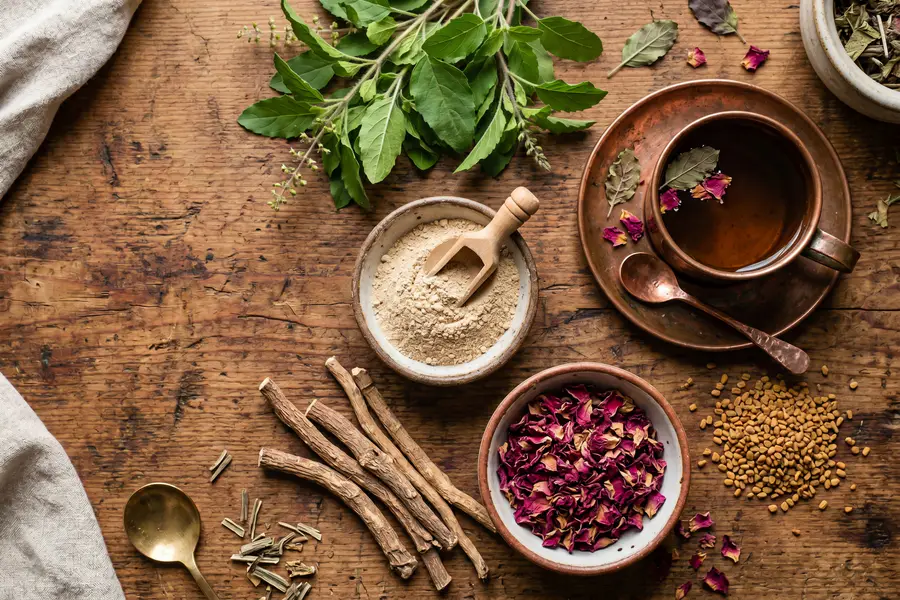
Tulsi is easy to incorporate: it is brewed as a tea that can be consumed daily without significant contraindications at moderate amounts.
Fenugreek and Maca — Menopausal Support
Recommended primarily during peri- and postmenopause.
Fenugreek (Trigonella foenum-graecum), also known as methi, contains phytoestrogens — plant compounds that gently compensate for the decline in estrogen during menopause. It supports adrenal function and libido. Research confirms its effectiveness in reducing menopausal symptoms.
Maca (Lepidium meyenii) — while not a classical Ayurvedic plant, it is widely used in integrative women’s health protocols. Clinical evidence supports its role in reducing the frequency and intensity of hot flashes, and in supporting the body’s own sex hormone production.
Chyawanprash — The Ayurvedic Tonic for Everyone
Suitable for all ages and all three doshas as a foundational strengthening tonic.
Chyawanprash is an ancient Ayurvedic herbal jam whose base ingredient is amalaki (Indian gooseberry) — one of the richest natural sources of vitamin C. It contains dozens of herbs, spices, ghee, and honey.
Nourishes and protects ojas — the vital essence that Ayurveda considers the foundation of immunity and reproductive health. And stimulates digestion, supports immunity, and delivers a broad spectrum of antioxidants.
A Key Principle: Agni First, Then Herbs
Ayurveda holds to a strict sequence: no rejuvenating herb or adaptogen will deliver its full potential if digestion is compromised. Ama blocks the channels of circulation, and the active compounds in herbs simply never reach their target tissues.
The correct sequence is always this: restore agni — clear ama — and only then introduce adaptogens and rasayana.
Conclusion
The Body Is Always Speaking — Learning to Listen Is the Work
Hormonal imbalance doesn’t happen in a single day. It builds gradually — across months and years of subtle deviations, which the body patiently signals long before pronounced symptoms appear. Ayurveda doesn’t ask us to silence those signals. It asks us to learn to read them.
Thousands of years before endocrinology existed. Ancient texts described principles that modern research continues to confirm, one study at a time. Doshic balance is a concrete system for understanding how stress, nutrition, daily routine. Lifestyle shape and the hormonal health of every individual woman.
Three core principles run through everything covered in this article:
First — health begins with digestion. Strong agni is the foundation without which no herb, practice, or dietary change will deliver lasting results. Restoring the digestive fire is always the first step.
Second — the cause matters more than the symptom. Painful periods, PCOS, difficult menopause — none of these are accidents. Behind each lies a specific doshic imbalance that can be identified and addressed.
Third — consistency matters more than intensity. Small daily actions — a consistent bedtime, a warm breakfast, a morning practice, a bitter taste at the end of a meal — produce lasting results. Occasional intensive efforts without a system don’t.
Starting small is enough. Building a daily routine. Paying attention to the quality of digestion. Observing the menstrual cycle as a source of information about the state of the body. Adding one morning practice — meditation, for example. Regular meditation lowers cortisol, restores hormonal balance, and cultivates the stable inner state that Ayurveda calls ojas. The “Inner Support 1.0″ course was created to help take that first step.
Each of these steps is already movement toward balance.
>For those who want to go deeper into their individual constitution and build a personalized approach to hormonal health — the website has a growing collection of materials and tools to support the next step.
Related Posts

What Is a Dosha: The Three Energies That Define Our Nature
Ayurveda is one of the oldest systems of medical knowledge in the world. Its history…

Eating for Your Dosha: Gut Health and Digestion Through Ayurveda
Contents Introduction Agni — The Digestive Fire That Matters More Than Any Diet The Four…

Skin by Dosha: Why Acne, Dryness and Inflammation Appear
«The radiance of the skin, its even tone, softness and delicacy — these are the…