
Light Therapy Lamp or Glasses: How to Choose a Device Without Harming Your Eyes
Contents
- Introduction
- Two Types of Devices: Lamps and Glasses
- How to Choose a Light Therapy Lamp
- How to Choose Light Therapy Glasses
- Lamps vs Glasses: Which Is More Effective
- Precautions
- Conclusion
Introduction
The light therapy market has grown fast. Shelves now hold dozens of lamps, glasses, panels, and gadgets with bold promises. Some of them genuinely work. Others look good but fail to deliver the right intensity. A few can actually damage your eyes.
This article is a practical guide to choosing a home light therapy device. No unnecessary theory — just criteria, parameters, and clear benchmarks.
If you are not yet familiar with how light therapy works and why insufficient light affects mood, energy, and circadian rhythms, start with the article “Seasonal Depression: What a Lack of Light Does to the Brain and How Biohacking Can Help.”
Two Types of Devices: Lamps and Glasses
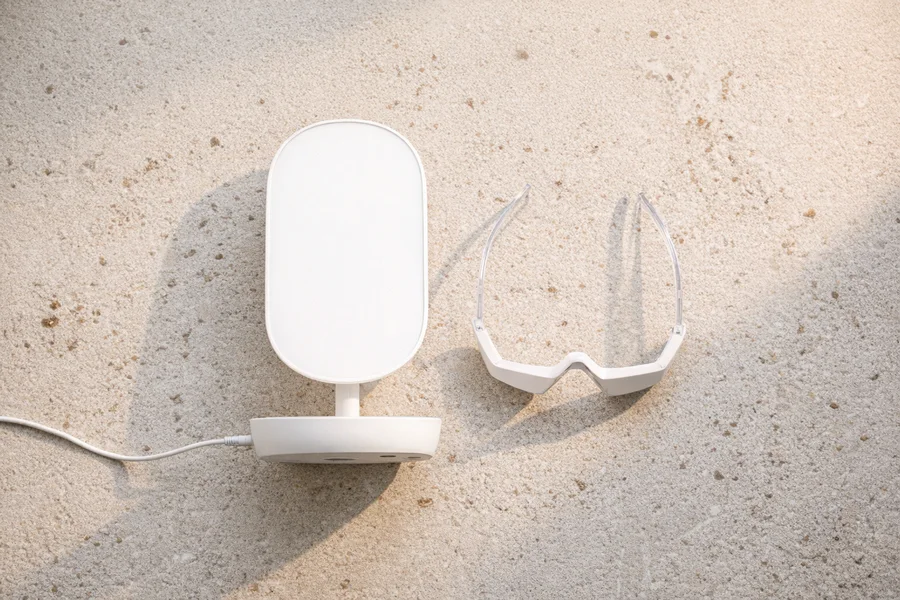
There are two main types of home light therapy devices: lamps and light therapy glasses. Both target the same retinal receptors. Both serve the same purpose: delivering enough blue light in the morning to trigger the circadian rhythm. They just do it differently.
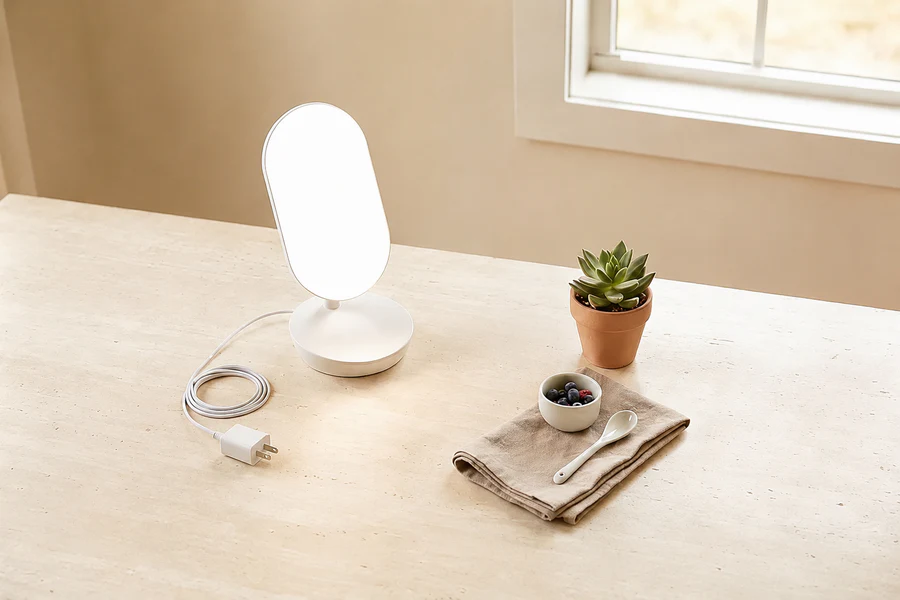
Lamps are the classic format. Most clinical research has been conducted with them. A person sits 30 to 50 centimeters from the panel for 20 to 30 minutes. The light is diffuse. It is not aimed directly into the eyes, which makes it comfortable and safe.
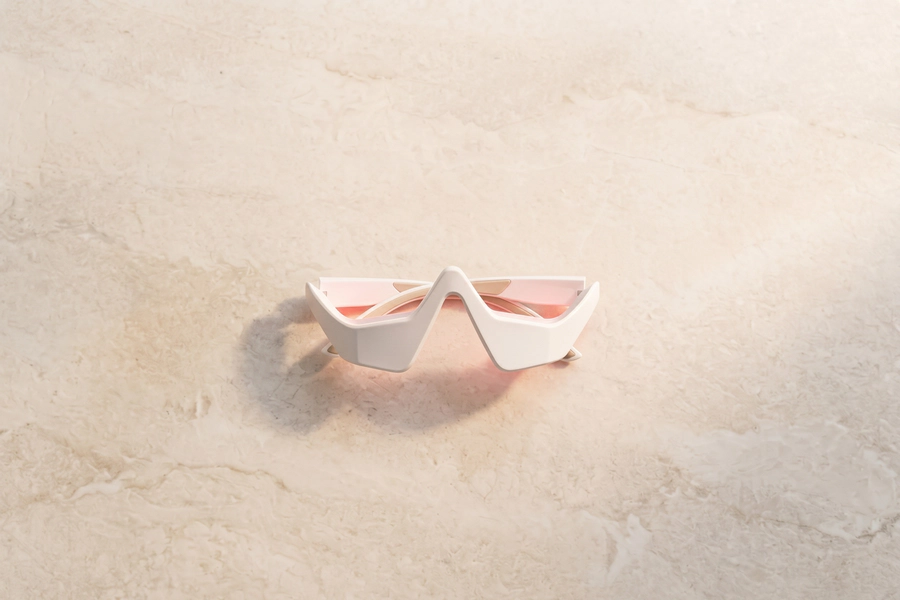
Light therapy glasses are a newer, more compact format. The light source sits 1 to 2 centimeters from the eyes. It is directed upward toward the lower retina, where photosensitive ganglion cell density is highest. This allows a lower absolute intensity to produce a comparable biological effect. Hands stay free — you can eat breakfast, read, or walk.
Both types are effective. The right choice depends on your lifestyle, budget, and goals.
How to Choose a Light Therapy Lamp
Intensity: The Key Parameter
The clinically proven standard is 10,000 lux at 30 to 50 centimeters. This combination appears in all major studies and international clinical guidelines.
One critical detail: the specification must state the distance. “10,000 lux” without a distance figure tells you nothing about real-world effectiveness. Any light source hits 10,000 lux if held close enough to the face. Look for: “10,000 lux at 30 cm” or “10,000 lux at 12 inches.”
Panel Size
The minimum useful size is 30 by 20 centimeters. Larger is better — 40 by 30 or above. A bigger surface provides even illumination. It requires less precise positioning. It is also much easier on the eyes. Small panels cause fatigue faster.
No Flicker
Frequency should exceed 3,000 Hz — or the lamp should use direct current (DC) technology. Flicker at 50 to 100 Hz, common in cheap lamps, causes eye strain and headaches. It also reduces therapy effectiveness. Look for “flicker-free” or “high-frequency ballast” in the specifications.
UV Filter
A UV filter is non-negotiable. The lamp must provide 99.3% UV protection or carry a “UV-free” label. Without a UV filter, the device is harmful to the retina and skin.
Spectrum and Color Temperature
The optimal range is 5,000 to 6,500 Kelvin — white or cool-white light with a spectral peak in the blue zone at 460 to 480 nanometers. Warm light at 2,700 to 3,000 Kelvin contains little blue and is ineffective for circadian stimulation.
Certification
Reliable devices carry medical certification: FDA (United States), CE (Europe), or Health Canada. This is not a guarantee of perfect quality. It is, however, a basic marker of safety and standards compliance.
LED or Fluorescent
Fluorescent lamps are proven technology. The light is more uniform and the price is lower. The downside: bulbs need replacing every 2 to 3 years, and some models contain mercury. LED lamps are newer and more durable — up to 50,000 hours. They are lighter and more energy-efficient. The downside: cheap LED lamps often flicker. When choosing LED, pay close attention to the flicker-free specification.
| Parameter | Minimum | Optimum |
| Intensity | 10,000 lux at 30 cm | 10,000 lux at 50 cm |
| Panel size | 30×20 cm | 40×30 cm or larger |
| Flicker | <3,000 Hz | DC technology |
| UV filter | 99.3% | 99.9% |
| Color temperature | 5,000K | 5,500–6,500K |
| Certification | CE or FDA | CE + FDA |
How to Choose Light Therapy Glasses
Intensity
Light therapy glasses do not list lux directly. Instead, manufacturers state the equivalent intensity of a traditional lamp. The light source sits 1 to 2 centimeters from the eyes. At that distance, absolute lux figures lose practical meaning.
The benchmark to look for is a 10,000 lux equivalent. If the specifications say “clinically proven equivalent to 10,000 lux,” that is a good sign. If there is no intensity data at all, do not buy the device.
One important research note: blue light is effective at far lower absolute doses than full white spectrum light. Suppressing melatonin requires only 200 to 500 lux of blue light, compared to 2,500 to 10,000 lux of white light. This is why glasses delivering 1,000 to 1,500 lux can match the effect of a 10,000 lux lamp.
Wavelength
Circadian stimulation requires blue light at 460 to 480 nanometers. This is the sensitivity peak of photosensitive retinal ganglion cells. Look for: “blue light,” “470 nm peak wavelength,” or “blue LED technology.” Some models use green light at 500 nm. It is gentler on the eyes, but sessions need to be longer.
Light Direction
This is one of the most important parameters. Two designs exist.
Bottom-up direction is the modern standard. Light targets the lower retina, where photosensitive cell density is highest. Vision is not blocked. You can work, read, cook, or walk during a session. Leading manufacturers use this design.
Direct illumination means light shines straight into the eyes. It is blinding, disruptive, and tiring. This design appears in cheaper models.
UV Filter
A UV filter is essential — even more so than in lamps, since the light source is millimeters from the eyes. All quality models carry “UV-free” labeling. No label means do not buy.
Weight and Ergonomics
The ideal weight is under 100 grams. Heavier glasses press on the nose and become uncomfortable during 20 to 30 minutes of use. Good glasses have adjustable arms and nose pads. They should also fit over prescription glasses — this matters for anyone who wears them.
Session Duration
The standard protocol is 20 to 30 minutes. A claim of “just 10 minutes is enough” is almost always marketing. A recommended duration of over 60 minutes signals that the device lacks sufficient intensity.
Battery Life
Aim for at least 5 sessions per charge. Less than that means charging every day or every other day, which quickly becomes inconvenient.
App
An app is not required for effectiveness. It does, however, make things considerably more convenient. The best apps analyze your chronotype, time zone, and goals. They suggest a personalized session schedule. They also adjust automatically when you travel across time zones.
| Parameter | Minimum | Optimum |
| Intensity | Equivalent 7,500 lux | Equivalent 10,000 lux |
| Wavelength | 460–500 nm | 465–475 nm (blue) |
| Light direction | Bottom-up | Bottom-up |
| UV filter | Required | UV-free label |
| Weight | <100 g | <80 g |
| Session duration | 20–30 min | 20–30 min |
| Battery life | 5 sessions | 8–10 sessions |
Lamps vs Glasses: Which Is More Effective
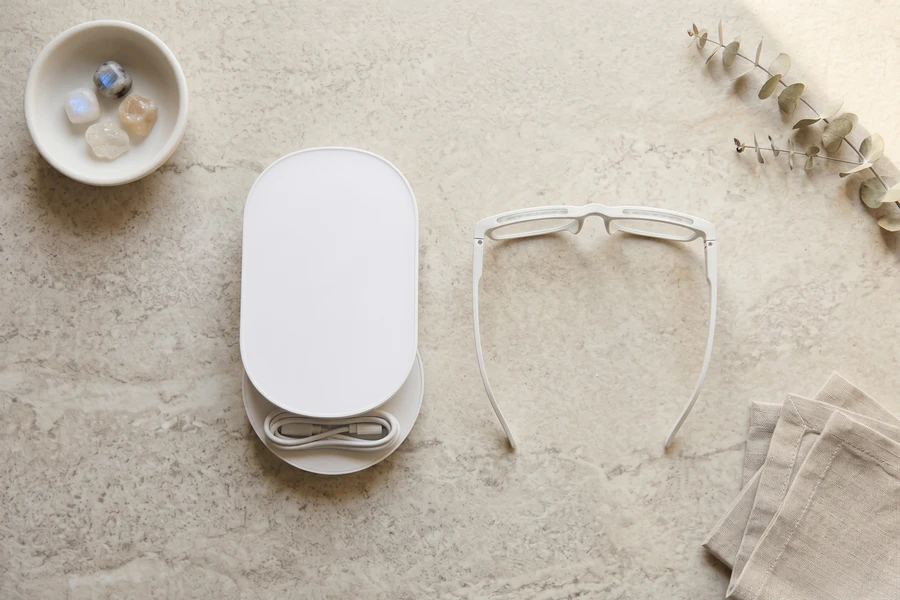
A 2020 study in the Journal of Affective Disorders gives a direct answer. Forty patients with seasonal depression were split into two groups. The first used a 2,000 lux lamp for 30 minutes each morning. Second – used 500 to 1,000 lux glasses for 30 minutes each morning. The course ran four weeks.
Results: the lamp group improved by 65%. The glasses group improved by 58%. The difference was not statistically significant. One detail stood out, though. Glasses users missed far fewer sessions. The reason was simple — glasses fit more easily into a morning routine. Consistency matters more than absolute intensity.
When to Choose a Lamp
A lamp is the better choice for severe clinical seasonal depression. Maximum proven effectiveness matters most here. It also suits people with sensitive eyes — diffuse light is gentler than direct light. Budget is another factor: a quality lamp costs 30 to 50% less than good glasses.
When to Choose Glasses
Glasses work best for people who cannot set aside 30 minutes of stationary sitting. Hands stay free. Sessions combine with breakfast, a walk, or work tasks. They are also ideal for frequent travelers dealing with jet lag — compact, battery-powered, and some models adjust the protocol automatically across time zones.
Combining Both
The optimal approach is to use both. A lamp at home each morning provides the baseline protocol. Glasses serve as a mobile option when traveling, at the office, or on days when the usual routine is disrupted.
Precautions
Light therapy is safe for most people. In certain situations, however, consulting a specialist before starting is advisable.
Eye Conditions
Cataracts, glaucoma, retinal degeneration, and other eye conditions require an ophthalmologist consultation first. In some cases, bright light can worsen retinal damage.
Bipolar Disorder
Bright morning light can trigger a manic or hypomanic episode. Light therapy is possible with this diagnosis, but only under psychiatric supervision and with a carefully calibrated protocol.
Photosensitizing Medications
Some medications increase light sensitivity. These include certain antibiotics, diuretics, antipsychotics, and acne treatments. If you take any medication regularly, check with a doctor or pharmacist for photosensitizing effects.
Autoimmune Conditions with Light Sensitivity
In systemic lupus erythematosus and some other autoimmune conditions, bright light can trigger a flare. In these cases, light therapy should only be used with approval from the treating physician.
Conclusion
Choosing a light therapy device seems complicated — until you understand the main point. Both formats work. The difference is not effectiveness. The difference is which one you will actually use.
Everyone’s morning is different. Some people can sit calmly in front of a lamp over breakfast. Others are out the door in five minutes. The device needs to fit real life, not an ideal one.
Everything else is just the parameters we covered above.
This material is for informational purposes only and does not constitute medical advice. Before starting light therapy in the presence of psychiatric or eye conditions, please consult a doctor.
Related Posts

Liquid Amino Acids: Kitchen Biohacking for Tasty and Healthy Eating
Table of Contents Introduction What Are Liquid Amino Acids Amino Acids and Protein: What Is…
Neurosensory Therapy: Brain Biohacking Without Pills for Anxiety, Depression, and ADHD
Contents Introduction What Is Neurosensory Therapy Audio-Visual Entrainment (AVE) Vibroacoustic Therapy Binaural Beats and Brainwave…
Seasonal Depression: What a Lack of Light Does to the Brain and How Biohacking Can Help
Contents Introduction What Is Seasonal Depression Why Light Is Missing: The Biochemical Mechanism The History…