
Light Deprivation: Why You Are Tired, Low, and Gaining Weight

Contents
- Introduction
- Light as a Nutrient: What Happens in the Cell
- How Light Controls the Body Through the Eyes
- What Happens in the Evening: Blue Light and Hormonal Chaos
- The Cost of Light Deprivation: Depression, Weight, Aging
- A Healthy Light Protocol
- Conclusion
Introduction
You sleep eight hours. You still wake up exhausted. By midday, the fatigue is so heavy you could lie down at your desk. In the evening, the body is drained — but sleep won’t come. Weight creeps up despite a controlled diet. Mood swings arrive without a clear reason.
Modern medicine reaches for tests, supplements, and antidepressants. Increasingly, however, the root of the problem is neither blood chemistry nor willpower. It is hidden in the way you live with light.
The human body evolved under the sun for three and a half billion years. Every cell is calibrated to rhythms of light and darkness. Every hormone is synchronized with sunrise and sunset. Yet for the past 150 years — a negligible moment on the evolutionary timeline — we have lived in constant artificial twilight. We are paying for it with our health.
Light is a nutrient. It is as essential as water, food, and oxygen. Its deficiency triggers a cascade of disruptions that medicine typically addresses only at the symptom level.
Light as a Nutrient: What Happens in the Cell
Mitochondria produce ATP — the cell’s universal energy currency. Everything you do — thinking, moving, breathing — requires ATP. Mitochondria do not only produce ATP from glucose. They also produce it from light.
For more on the role of mitochondria in the body’s energy systems, see the article “The Cell’s Energy Source: How Your Body Works From the Inside Out.”
What Is Cytochrome C Oxidase
Inside mitochondria sits an enzyme called cytochrome c oxidase. It is the final link in the cellular respiration chain. This enzyme contains copper and iron atoms. They can absorb photons in the red and near-infrared range. When light reaches cytochrome c oxidase, three things happen.
First, ATP production accelerates by 30 to 40 percent. Cells receive more energy for repair, division, and protein synthesis. Second, mitochondria operate more efficiently. They produce fewer reactive oxygen species — the main drivers of chronic inflammation and accelerated aging. Third, nitric oxide is released. It dilates blood vessels, improves circulation, and increases oxygen delivery to tissues.
When a person spends the day under dim artificial light, this process slows down. Mitochondria work at half capacity. Energy is scarce. All body processes decelerate. The body begins breaking down slowly from within. This is what manifests as chronic fatigue with no apparent cause.
How Light Controls the Body Through the Eyes
Light affects the body through two pathways: through the skin and through the eyes. The second is far more powerful.
The retina contains specialized cells called photosensitive ganglion cells. They do not form images. Their job is to detect blue light intensity and report to the brain: is it day or night?
The signal from these cells travels to the suprachiasmatic nucleus of the hypothalamus — the body’s master biological clock. From there, circadian rhythms are governed for every organ and every cell.
The Morning Cascade
When bright, blue-spectrum light enters the eyes in the morning, the suprachiasmatic nucleus fires a cascade of reactions. Melatonin is suppressed — you wake up. Cortisol rises — energy and focus follow. Core body temperature increases — metabolism accelerates. A 24-hour timer starts. In 14 to 16 hours, the body will begin preparing for sleep.
This is full-system synchronization. The adrenal glands know when to release adrenaline. The pancreas knows when to be sensitive to insulin. Gut knows when to activate digestion. The brain knows when it will hit peak productivity. Light conducts all of it.
When there is no bright morning light — and for most urban dwellers, there is not — this cascade fires weakly or not at all. The day begins desynchronized. Everything else follows suit.
What Happens in the Evening: Blue Light and Hormonal Chaos
Evening is a critical time for circadian rhythm. The body should begin preparing for sleep: lowering temperature, dropping cortisol, starting melatonin production. Our habits interfere with all of this.
Smartphones, laptops, and televisions emit bright blue light. The peak wavelength sits around 450 to 480 nanometers. Photosensitive retinal ganglion cells read it as midday sun. The brain receives a clear message: it is daytime, too early for sleep.
Research shows that two hours of screen exposure before bed cuts melatonin levels in half. It also significantly delays sleep onset.
The Fatigue Cycle
When melatonin is delayed, cortisol fails to drop. The nervous system stays on low-level alert. Deep sleep phases shorten. In the morning, the person wakes not rested, but carrying an accumulated recovery deficit.
This is adrenal fatigue in its everyday form. Drowsy all day, unable to sleep at night. The longer the body stays in this mode, the more deeply the disruption embeds itself across all systems. Returning to a normal rhythm becomes harder with every passing week.
The Cost of Light Deprivation: Depression, Weight, Aging
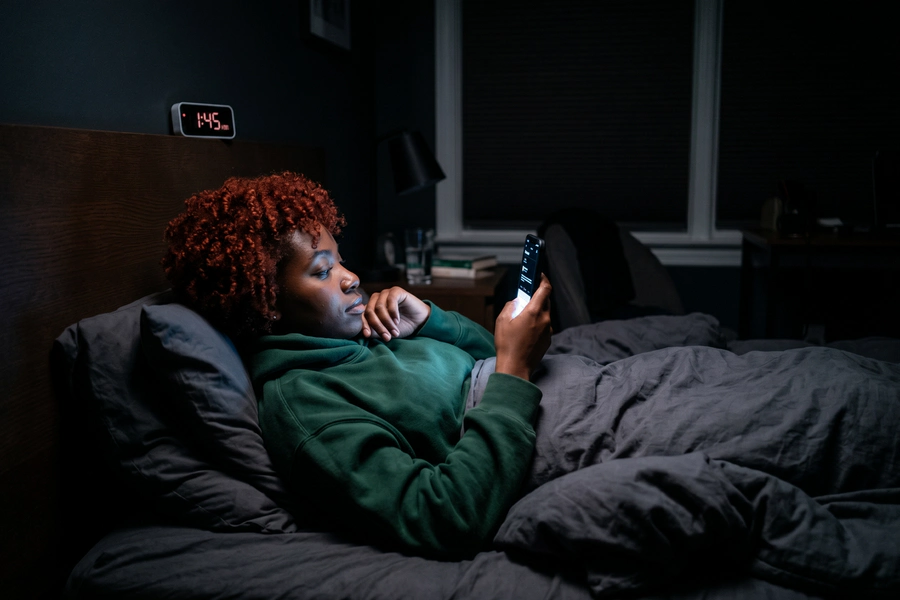
Bright morning light drives serotonin production — the neurotransmitter responsible for mood stability and motivation. Without enough light, serotonin output falls short. Dopamine pathways in the brain activate less readily, bringing apathy and a loss of interest in familiar activities. The prefrontal cortex functions less effectively, increasing anxiety.
Up to 10 percent of people in northern latitudes experience seasonal depression. In modern cities, however, light deprivation exists year-round — even in summer, for anyone who spends most of the day indoors.
For more on the mechanism of seasonal depression and its treatment, see the article “Seasonal Depression: What a Lack of Light Does to the Brain and How Biohacking Can Help.”
Weight and Metabolism
The connection between disrupted sleep and weight gain is direct and measurable. Chronic sleep deprivation lowers leptin — the satiety hormone — and raises ghrelin — the hunger hormone. A person feels hungry constantly, even after eating.
At the same time, insulin resistance develops. Cells stop responding properly to insulin. Glucose goes unprocessed and is stored as fat. Chronically elevated cortisol from poor sleep drives visceral fat accumulation — fat around the organs. Metabolic syndrome gradually takes hold.
This is why weight increases even with a clean diet. The problem lies in hormones. Hormones that light controls.
Immunity and Aging
Melatonin is not just a sleep hormone. It is one of the body’s most potent antioxidants and immune modulators. When it is chronically deficient, immune function declines. Oxidative stress — the primary mechanism of aging — intensifies.
Leading biohackers consistently name quality sleep as the foundation of longevity. But quality sleep is impossible without healthy circadian rhythms. And healthy circadian rhythms are impossible without the right light.
A Healthy Light Protocol
Correcting light deprivation requires three things: the right light in the morning, the right light in the evening, and darkness at night.
Morning
The first 20 to 30 minutes after waking are the most important light window of the day. Сircadian system is most receptive to light signals at this time.
The ideal step is to go outside. Even an overcast sky delivers 10,000 lux — 20 to 30 times more than typical indoor lighting. If going outside is not possible, stand at an open window for at least 10 minutes. Glass blocks part of the relevant spectrum, so direct exposure to outdoor light is preferable.
If you live at northern latitudes or wake before sunrise, use a 10,000 lux light therapy lamp. For guidance on choosing the right device, see the article “Light Therapy Lamp or Glasses: How to Choose a Device Without Harming Your Eyes.”
Twenty minutes of morning light suppresses melatonin by 80 percent. It triggers cortisol release and synchronizes the biological clock.
Daytime
Throughout the day, the goal is maintaining sufficient light exposure. Work near a window when possible. Take light breaks every two hours — 5 to 10 minutes at a window or outside. Even on cloudy days, this is significantly better than office lighting.
Evening
Two to three hours before bed, start reducing light intensity and color temperature. Turn off overhead lights. Switch to floor lamps and candles with a warm spectrum around 3,000 Kelvin. One hour before sleep — no screens. If that is not possible, use blue light blocking glasses or enable night mode on all devices.
Night
The bedroom should be as dark as possible. Blackout curtains, covered LED indicators on chargers and routers, a room temperature of 18 to 20 degrees Celsius. When blue light disappears, melatonin begins to rise. It peaks within 2 to 3 hours. Cortisol drops. The body enters recovery mode.
Conclusion
We have learned to fly to space, edit genes, and print organs. Yet we have forgotten something humans did for millions of years — living in rhythm with light and darkness.
It is strange to consider that exhaustion after eight hours of sleep, depression without a clear cause, and weight that refuses to shift despite genuine effort might all share a single root. Something this simple. Something this invisible.
Light came first. Life evolved within it and for it. Returning to that simple fact may be the most underrated step toward health.
This material is for informational purposes only and does not constitute medical advice. If you have chronic conditions, psychiatric disorders, or sleep disturbances, please consult a doctor.
Related Posts

Liquid Amino Acids: Kitchen Biohacking for Tasty and Healthy Eating
Table of Contents Introduction What Are Liquid Amino Acids Amino Acids and Protein: What Is…

Neurosensory Therapy: Brain Biohacking Without Pills for Anxiety, Depression, and ADHD
Contents Introduction What Is Neurosensory Therapy Audio-Visual Entrainment (AVE) Vibroacoustic Therapy Binaural Beats and Brainwave…

Seasonal Depression: What a Lack of Light Does to the Brain and How Biohacking Can Help
Contents Introduction What Is Seasonal Depression Why Light Is Missing: The Biochemical Mechanism The History…