
Seasonal Depression: What a Lack of Light Does to the Brain and How Biohacking Can Help
Contents
- Introduction
- What Is Seasonal Depression
- Why Light Is Missing: The Biochemical Mechanism
- The History of Light Therapy: From Experiment to Gold Standard
- How Light Therapy Works: Circadian Rhythms and Blue Light
- Light Therapy vs Antidepressants
- How to Use Light Therapy at Home
- Precautions
- Conclusion
Introduction
The urge to sleep for ten hours. Cravings for something sweet and heavy. The desire to avoid people and postpone everything. Many people attribute this to personality or laziness. In reality, however, it comes down to specific biochemistry — and a specific solution.
Depression is the brain’s physiological response to insufficient light. Biohacking has a precise tool for this: light therapy.
What Is Seasonal Depression
Seasonal depression, or Seasonal Affective Disorder (SAD), is a clinical type of depression that occurs at a specific time of year. In 90% of cases, it follows the autumn-winter pattern. Symptoms appear in October and November, peak between December and February, and lift in spring when sunlight returns.
Who Is at Risk
The condition is especially prevalent in northern latitudes, where the difference in daylight hours between summer and winter is most pronounced. In summer, daylight lasts 14 to 16 hours. In winter, it drops to just 8 or 9.
Symptoms of Seasonal Depression
SAD affects multiple levels — emotional, physical, and behavioral. Low mood and loss of interest in familiar activities combine with persistent fatigue and a desire to sleep far longer than usual. Appetite increases, particularly for carbohydrates and sweets, and this is often accompanied by weight gain. Concentration declines, thinking slows, and cognitive function deteriorates. A person increasingly withdraws from social contact and puts off routine tasks.
All of this, importantly, is brain biochemistry deprived of sufficient light.
Why Light Is Missing: The Biochemical Mechanism
Every symptom of seasonal depression has a specific biochemical process behind it.
Melatonin and Drowsiness
The retina contains specialized cells called photosensitive ganglion cells. These cells do not form images. Instead, they detect the intensity of blue light and inform the brain whether it is day or night. This signal travels to the suprachiasmatic nucleus of the hypothalamus — the body’s master circadian regulator.
When daylight hours are short and light intensity is low, melatonin — the sleep hormone — is not suppressed adequately. The brain receives the message that “night” arrives earlier and lasts longer. The result is persistent drowsiness, sluggishness, and the sense that the body wants to sleep even after eight hours of rest.
Serotonin and Depression
Serotonin is a neurotransmitter responsible for mood stability, motivation, and a sense of wellbeing. It is also the precursor to melatonin — the brain synthesizes melatonin from serotonin in the evening.
Without sufficient light, serotonin production becomes less efficient. Its deficit is directly linked to depressive states, anxiety, and apathy. In SAD, research documents heightened activity of serotonin transporters — proteins that remove serotonin from the synaptic cleft too quickly, preventing it from functioning. This is one of the key biochemical mechanisms of the disorder.
Dopamine and Motivation
Insufficient light also disrupts the dopamine system. Dopamine governs motivation, the ability to experience pleasure, and the drive to pursue goals. Its decline explains the anhedonia characteristic of SAD — a loss of interest in things that previously brought joy.
Vitamin D and Neurotransmitters
A lack of sunlight inevitably leads to reduced vitamin D levels. This worsens the situation, because vitamin D plays a role in the synthesis of serotonin and dopamine. Vitamin D deficiency is an independent risk factor for depression — one that compounds light deprivation during winter months.
Circadian Shift
Together, these processes produce a shift in circadian rhythms. The body’s biological clock begins operating on a “winter schedule”: the system believes it should sleep more, eat more, and conserve energy. This is an evolutionarily grounded response to winter. In modern life, however, it becomes a functional disorder.
The History of Light Therapy: From Experiment to Gold Standard

In the early 1980s, American psychiatrist Norman Rosenthal encountered the problem of light deficiency firsthand. After moving from sunny South Africa to overcast New York City, he noticed that his mood and productivity deteriorated significantly each autumn. This observation became the starting point for research that would reshape psychiatry.
Rosenthal proposed a straightforward hypothesis: if winter depression is caused by insufficient light, then artificially extending the daylight period should help. Together with engineers, he developed a specialized light panel producing 2,500 lux — the maximum achievable at the time.
The First Experiment
Single participant in the first trial was instructed to sit in front of the panel for three hours in the morning and three hours in the evening. The goal was to artificially lengthen the day. This experiment ran for two weeks.
The results were compelling. After just four days, the participant reported significant improvement. By the end of the second week, symptoms of depression had disappeared entirely. When therapy was stopped, symptoms returned within a week. When it resumed, they disappeared again.
The conclusion was clear: this works. Larger studies, however, were needed.
The Gold Standard
Over the following nine years, randomized clinical trials were conducted. By 1989, the gold standard of light therapy had been established — and it remains current today: 10,000 lux, 30 minutes in the morning, within the first two hours after waking.
In 2015, a meta-analysis combined results from 20 controlled studies involving more than 500 patients with diagnosed seasonal depression. The standard protocol was 10,000 lux, 30 minutes each morning, over a course of 4 to 6 weeks. The findings showed 67% of patients achieved full remission, 90% showed significant improvement, and effects appeared within 1 to 2 weeks of starting therapy.
Light therapy has since been included in all international clinical guidelines for the treatment of seasonal depression and has received the highest level of evidence in the scientific community.
How Light Therapy Works: Circadian Rhythms and Blue Light
Understanding the mechanism behind light therapy explains why lux intensity, light spectrum, time of day, and distance from the source all matter.
Lux and Nanometers
Clinical studies refer to 10,000 lux — but lux measures light intensity, not color. Nanometers are a different parameter entirely: they describe wavelength, which corresponds to color.
For context, standard household lamps produce 300 to 500 lux. That is 20 to 30 times below the therapeutic threshold. Even if the lamp’s spectrum includes the relevant wavelengths, the intensity is too low to influence circadian rhythms or suppress melatonin.
Both parameters matter and work together. Lux determines whether the intensity is sufficient. Nanometers determine whether the light targets the right biological range.
Why Blue Light
Photosensitive ganglion cells in the retina are most responsive to blue light in the 460 to 480 nanometer range. This is the spectrum that most effectively suppresses melatonin and signals the brain that daytime has begun.
The signal from these cells travels to the suprachiasmatic nucleus of the hypothalamus. The body’s master circadian pacemaker. From there, a chain of responses is triggered. Cortisol production normalizes in the morning, serotonin throughout the day, and melatonin in the evening. The biological clock resets to a healthy rhythm.
Why Timing Matters
A morning light therapy session is not an arbitrary choice. The circadian system is most receptive to light signals in the morning. Exposure within the first two hours after waking delivers the maximum benefit for the rest of the day. An evening session, by contrast, can shift the circadian rhythm in an undesirable direction and disrupt sleep onset.
Why Sunlight Is Best — and Why It Is Not Enough
Natural sunlight delivers more than 100,000 lux and provides the full spectrum. Biologically, it is the ideal source. In winter months at northern latitudes, however, there is simply not enough of it. Days are short, the sun stays low on the horizon, and intensity is reduced. Most people, moreover, spend nearly all of winter indoors.
This is where biohacking enters the picture. Specialized light therapy devices allow individuals to take control of their light exposure — regardless of the weather, geography, or schedule.
Light Therapy vs Antidepressants
Light therapy works quickly. In most studies, improvement was recorded within 1 to 2 weeks of starting the protocol. Antidepressants typically take significantly longer — usually 4 to 6 weeks from the first dose. For someone in the grip of seasonal depression, that difference is meaningful.
Side Effects
Antidepressants produce side effects in 40 to 50% of patients. The most common include sleep disturbances, reduced libido, weight gain, nausea, and discontinuation syndrome when treatment stops. Light therapy, when used correctly, has a minimal side effect profile. In rare cases, mild headache, eye strain, or irritability may occur in the first few days — and these typically resolve on their own.
Effectiveness
The 2015 meta-analysis of 20 controlled studies found that light therapy produced full remission in 67% of patients with seasonal depression and significant improvement in 90%. Direct comparative studies of light therapy and antidepressants for SAD show comparable efficacy. While light therapy acts more quickly and without systemic side effects.
A 2025 study published by Saveetha University confirmed that light therapy produces a statistically significant reduction in depression levels (p = 0.008), raises serotonin and dopamine levels, and improves biophysiological markers — including pulse, blood pressure, and BMI.
When Antidepressants Are Needed
Light therapy is an effective first-line treatment for mild to moderate seasonal depression. For severe depression, bipolar disorder, or non-seasonal depression, treatment decisions rest with a physician. In these cases, light therapy may serve as a complement to medication — but not as a replacement.
Individual genetic factors are also worth considering. The response to light therapy is partly determined by gene variants that regulate serotonin and dopamine synthesis and processing. If the standard protocol does not produce the expected result, this does not mean the method has failed. Additional support through nutrition, supplements, or protocol adjustments may be needed.
How to Use Light Therapy at Home
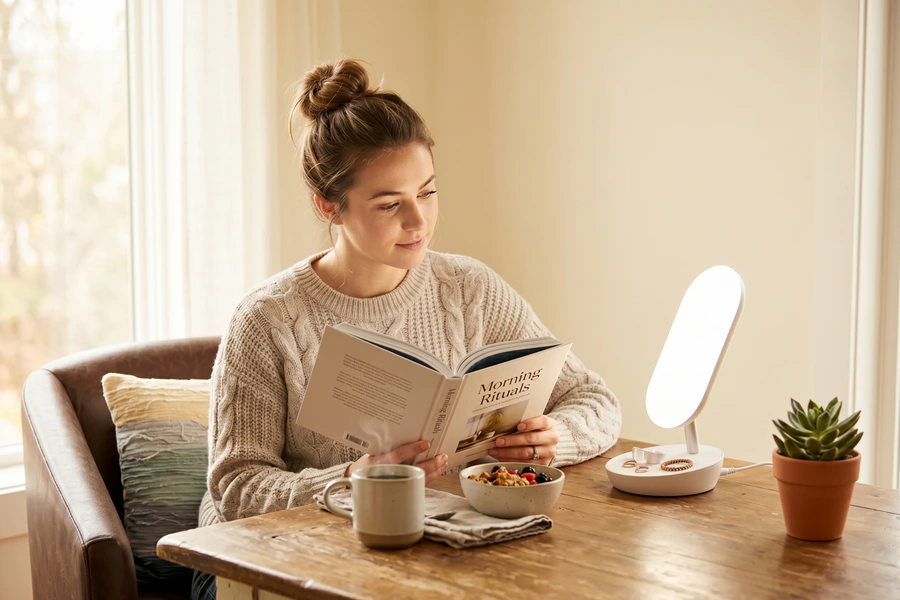
Light therapy is one of the few biohacking tools that is simultaneously well-researched, accessible for home use, and requires no special training. The key is choosing the right device and following the protocol.
Gold Standard Protocol
The clinically validated protocol is as follows: 10,000 lux, 30 minutes in the morning, within the first two hours after waking. This combination of parameters ensures effective melatonin suppression and circadian rhythm recalibration.
The device should be positioned 40 to 60 centimeters from the face. Eyes should be open, but direct eye contact with the light source is not necessary. Simply being within the exposure zone is sufficient. Eating breakfast, reading, or working at a computer during the session is perfectly fine.
Choosing a Device
Two parameters matter when selecting a light therapy device. The first is lux intensity: the device must deliver at least 10,000 lux at a distance of 40 to 60 centimeters. The second is spectrum: quality devices include the blue range of 460 to 480 nanometers, which most effectively targets circadian rhythms. Standard household lamps — even very bright ones — are not suitable. Their 300 to 500 lux output falls far below the therapeutic threshold.
For a detailed breakdown of selection criteria, format comparisons, and what to look for when buying, see the article “Light Lamp or Light Therapy Glasses: How to Choose a Device Without Harming Your Eyes.”
When to Expect Results
The first improvements typically appear within 1 to 2 weeks of following the correct protocol. A sustained effect develops over 4 to 6 weeks of regular use. Consistency matters more than session length — daily 30-minute sessions outperform infrequent hour-long ones.
Light Therapy as Part of a Morning Routine
Light therapy works best when combined with other morning practices. A session in front of the light device can be paired with breakfast, meditation, or reading. This does not add time to the morning routine — it simply changes the quality of light during that time.
Light is an important tool, but not the only one for restoring balance. Diet directly affects serotonin and dopamine synthesis through the gut-brain axis. For guidance on building a diet that supports mood and digestion, see the article “Eating for Your Dosha: Gut Health and Digestion Trough Ayurveda.”
The Seasonal Protocol
The optimal time to start light therapy is late September — before the first symptoms appear. Starting preventively makes it possible to avoid the development of SAD rather than treating an already established condition. The protocol continues through March and April, until natural sunlight returns in sufficient quantity.
Precautions
Light therapy is a safe method for most people. Nevertheless, certain situations call for caution or medical consultation before beginning.
Bipolar Disorder
This is the most important warning. Bright light can trigger a manic or hypomanic episode in people with bipolar disorder. Light therapy is possible with this diagnosi. But only under psychiatric supervision and with a carefully calibrated protocol.
Eye Conditions
People with cataracts, glaucoma, retinal degeneration, or other eye conditions should consult an ophthalmologist before starting light therapy. In some conditions, bright light can worsen retinal damage.
Photosensitizing Medications
Certain medications increase the sensitivity of the skin and eyes to light. These include some antibiotics, antifungals, antipsychotics, and acne treatments. If you are taking any medication, check with a doctor or pharmacist whether it has a photosensitizing effect.
Systemic Lupus Erythematosus and Other Autoimmune Conditions
In some autoimmune conditions with heightened light sensitivity, bright light can trigger a flare. In these cases, light therapy should only be used with the approval of the treating physician.
Pregnancy
No specific contraindications to light therapy during pregnancy have been established. However, any changes to a treatment plan during this period are best discussed with the supervising healthcare provider.
Conclusion
Light therapy is one of the most thoroughly studied and evidence-based tools in biohacking. Light itself is one of the most powerful variables in human health.
We live in an era when most of our waking hours are spent indoors. Under artificial lighting that is 20 to 30 times below the therapeutic threshold. This is chronic light deprivation — and the brain reads it as an endless winter.
Fatigue, apathy, and the urge to sleep for ten hours are signals asking for a response. Recognizing them for what they are changes how we relate to our own condition.
This material is for informational purposes only. It does not constitute medical advice, diagnosis, or a treatment guide. Before using light therapy — particularly in the presence of psychiatric conditions, eye disease, or when taking medication — please consult a qualified healthcare professional.
Related Posts

Liquid Amino Acids: Kitchen Biohacking for Tasty and Healthy Eating
Table of Contents Introduction What Are Liquid Amino Acids Amino Acids and Protein: What Is…
Neurosensory Therapy: Brain Biohacking Without Pills for Anxiety, Depression, and ADHD
Contents Introduction What Is Neurosensory Therapy Audio-Visual Entrainment (AVE) Vibroacoustic Therapy Binaural Beats and Brainwave…
Light Deprivation: Why You Are Tired, Low, and Gaining Weight
Contents Introduction Light as a Nutrient: What Happens in the Cell How Light Controls the…